[PROPOSAL]: Gitcoin DAO 2026 Budget Request: Second Tranche (Revised and Expanded)
TL;DR
This request covers the second tranche of the DAO’s 2026 operating budget, covering July 2026 to December 2026. It revises and expands the second tranche that was outlined in the original 2026 Budget Request.
This is a $1M bet on our new direction, and if we’re successful, we’ll see inbound philanthropic capital to the value of $30M, and PMF across multiple cities.
When the 2026 budget was approved, we signalled that the year would be spent identifying the strategic focus that would define Gitcoin’s next era, with a decision expected toward year end. We have reached that focus ahead of schedule. That focus is a local-first platform, and this request resources its execution: advisory support, new hires, user acquisition, and a go-to-market motion that were not contemplated in the original second-tranche figure.
Why ‘We Are Back’ Early
We are continuing to Fund What Matters but instead of by/for Ethereum, we are funding what matters with Ethereum for the world. This is our logical continuation of all the work we’ve already accomplished thus far. We have conviction in this direction as there is an expected value of $30M more capital inflow into our work.
The original 2026 request framed the year as a search: lean operations, strategic optionality, and a focus decision expected at the end of 2026. That search has now been resolved.
We aim to build a local-first platform that helps AI-displaced professionals move from isolation into trusted, real-world communities that provide jobs, mutual aid, and eventually civic power. To move isolated, economically vulnerable individuals facing rapid technological displacement out of digital paralysis and into highly organized, resilient, federated real-world networks. These local networks will possess the collective economic weight, shared care infrastructure, and data sovereignty necessary to out-compete and permanently replace extractive corporate network monopolies.
We’re building a consumer app that helps people spend more time and money in their local community, instead of defaulting to online platforms and national chains. The app curates everything happening locally in one place: independently owned businesses, events, festivals, nonprofits, volunteer opportunities, and community gathering spots. It surfaces these local options at the moment someone is about to reach for an online default. When a user opens Amazon, the app can suggest a local shop that carries what they need. When they open Facebook looking for something to do, it can show who’s gathering nearby tonight.
The problem it targets: people consistently say they want to support local businesses, meet their neighbors, and spend less time online. But the information they’d need to actually do those things is scattered across dozens of sources, often out of date, and buried under algorithms designed to keep attention online. The app closes that gap by making local, in-person options as easy to find and act on as the online alternatives.
What the app will enable users to accomplish:
- Discover local businesses, events, and gathering places they didn’t know existed
- Find real things to do in their community on any given night
- Redirect everyday spending toward locally owned businesses
- Get involved with nonprofits and volunteer opportunities near them
- Spend less time on their phone and more time in their community
The New Strategy
What we are building
We are giving this a full, best-foot-forward try at product-market fit.
Core operating logic:
- Curate existing supply before creating new supply. Auto-ingest local directories, calendars, and nonprofit data; businesses can claim or opt out of their page. We don’t make the supply — we aggregate it and drive demand to it.
- Behavior-driving, not data harvesting. Collect only data tied to outcomes we’re driving (interests, location, explicit preferences, thumbs up/down on matches). If the information isn’t changing offline behavior, we’re failing.
- Many cities from day one (or very early). Network value scales superlinearly; single-city products can’t compete (the Uber lesson). An alpha testing zone; launch is closer to 10 cities, same app everywhere.
- Parallel, not replacement. This rides alongside the extractive economy. Moving even ~10% of local spend from monopolies into local circulation is the massive win.
Positioning category: intentional-tech / “I want to be on my phone less and in my community more” (adjacent to Light Phone, Daylight, Meadow). Localism / “I care about my local community and want to see it thrive”
The data layer (sovereign, locally owned, peer-verified — “the map of the town nobody can buy”) is retained as backend architecture and long-term theory of change, not the consumer pitch. Never lead with “data commons” outside technical audiences. Seeding this layer is now an active workstream.
North-star metric: a verified in-real-life action.
What does success look like in 2026
Through our external advisor and the new fundraising lead, we will be chasing large philanthropic funds deployed, in order to offset our spend and extend our runway.
How it relates to the existing Gitcoin Grants program
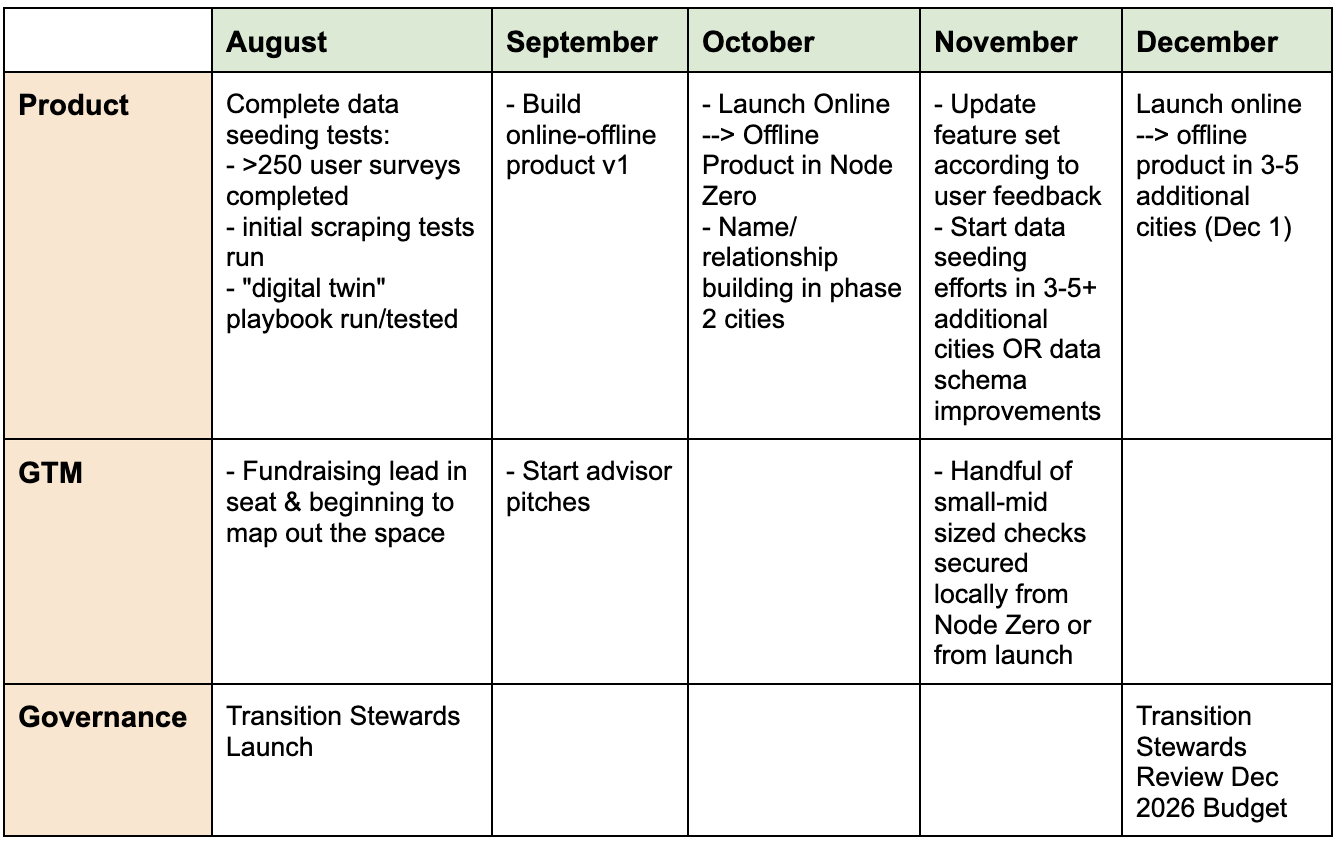
Gitcoin will still operate under two funding streams: the treasury that funds the DAO’s opex, and the matching pool funding any rounds we run. The matching funds will be used towards public goods, as is the mandate for the pool. We will be funding a Node Zero round with these funds in October.
In addition to the product we will build, we will continue to deploy capital allocation tools, such as QF, but to a broader network of builders outside of web3. We understand that the ecosystem is changing, and it’s time to expand beyond web3 to fully grab the market. This is aligned with our new AI resilience strategy
H1 2026 Progress
Operations and governance
Gitcoin Grants / program
We are actively shifting the Gitcoin Grants Program into a new fund that will continue funding public goods, yet rather focused on localism activities, real-world solutions as well as supporting this strategy directly.
H1 2026 spend summary
Q1 (Jan–Mar): $159,891 spent vs. $245,336 budget, a 34.8% underspend ($85,445). A deliberately lean experimentation quarter; the big variance was Venture Scale Bets at 67% under plan.
Q2 (Apr–Jun): $310,502 spent vs. $294,993 budget, a 5.3% overspend ($15,509). The overspend hides a recomposition, not growth: ~$115K moved from Venture Scale Bets (-92.3%) into product build under Other Consultants (+382%). The two lines offset within $272, so it’s one decision, not two.
Treasury and financial sustainability
The DAO stayed within its overall envelope for the half: ~$470K spent against ~$540K budgeted, roughly 13% under plan. The Q1 reserve of $85,445 more than covered the Q2 overage, so the overspend was funded from reserves in hand, not new draw, leaving ~$69,936 carried into H2. Headcount held to plan both quarters and software ran under, so runway discipline held; the real change is qualitative, with capital shifting from discretionary bets to direct build, plus the cost of the Tally migration and upgrades. Q3 watch-items are all new-category spend: elevated consultants, Venture Scale Bets sunsetting, paid acquisition, and G&A becoming a budgeted line.
Current Treasury Balance and runway
Current balance: $6,897,677.00 As of Jul 23, 2026

Current Matching Pool Balance and runway
Current balance: $10,189,330 As of Jul 23, 2026

Budget Request
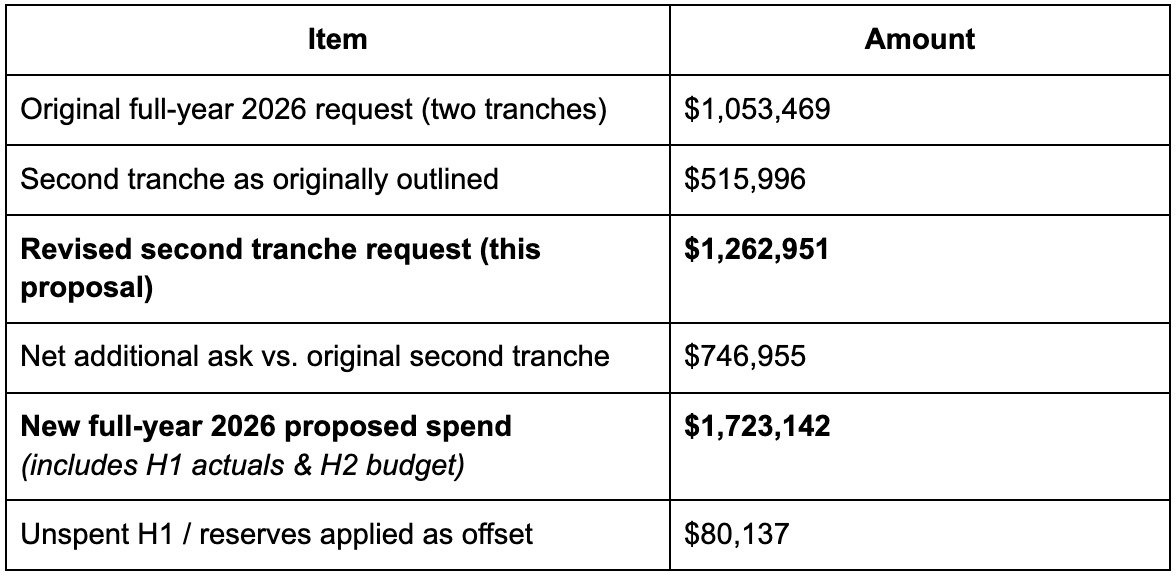
The DAO is requesting $1,182,814 (including reserve offset) as the revised second tranche, to fund July - December 2026. This is $666,818 above the second tranche as originally outlined, to resource the new strategy, minus reserve offset of unspent budget of H1.
This new funding accounts for a monthly advisor, new hires, lower-tier paid acquisition, podcast production and engineering costs.
We will continue to post quarterly updates on the forum to maintain accountability against this request.
Budget Breakdown and Team Structure
Team structure
| Role | Status | Focus Area |
|---|---|---|
| Chief of Staff and Head of Ops | Full-time | Operations |
| Marketing Lead | Full-Time | Marketing |
| Engineering Lead (new hire) | Full-Time | Engineering |
| Strategy Consultant | Part Time | Strategy |
| Fundraising & Growth Lead - hiring in process | Full-Time | Sales / BD |
| Product Lead (new hire) | Part Time | Product |
| Field Operator(s) - hiring in process | Part-Time | IRL Operations |
Additional support includes:
- External advisory support (monthly)
- Website design & engineering support (project-based contractors)
- Accounting management (new addition)
- Monthly legal support (new addition), which is in support of our potential refactor in the future.
- New hires expanded:
- Field Operator: on-the-ground presence and get the product into the community’s real social fabric, so that newly onboarded working professionals reliably take a verified real-world action
- Fundraising & Growth Lead: Ownership of philanthropic fundraising efforts.
- Product Lead: Ownership of product development and direction (onboarded).
- Engineering Lead: Building and owning the platform that Gitcoin 3.3 runs on (onboarded).
Detailed Cost Categories
A. Continuing DAO operations (second-tranche portion)
| Category | Amount |
|---|---|
| Head Count | $512,404 |
| Consultants | $460,050 |
| Software and subscriptions | $35,497 |
| Travel, Lodging & Meals | $10,000 |
| General & Administrative | $65,000 |
| Growth & Brand | $180,000 |
| Subtotal, continuing operations | $1,262,951 |
Category Breakdown:
Headcount:
This covers Full-Time and Part-Time contributors, focusing on Operations, Marketing, Strategy, Engineering, Product, Security Consultant, BD/Sales, Field Operations.
Consultants:
Includes other consultants we work with, including advisorship, support ops, website/design support, accounting management, EA & calendar management support, additional agency support for brand/marketing.
Software & Subscriptions:
Any paid subscriptions for product, engineering, operations, or otherwise administrative needs such as email, X, etc.
Travel, Lodging & Meals:
Any travel that’s covered by the DAO, including conferences, offsites, or general travel. NOTE: for H2, we do not have a large travel budget as we don’t plan on attending Devcon. Rather, we will hold a team offsite in August and sponsor a local, values aligned event during our launch period. If there are any alternative events that we plan to attend, this will be a separate budget request.
General & Administrative:
This cost includes any administrative costs associated with governance upgrades, unforeseen admin costs, stewardship program, or conference sponsorships.
Growth & Brand:
This is allocated towards Media (podcast production), & paid marketing acquisition.
Quarterly Budget Distribution
| Quarter | Amount |
|---|---|
| Q3 | $647,159 |
| Q4 | $615,793 |
| Total | $1,262,951 |
Reporting Framework
We will provide quarterly updates focused on:
- Progress against the new strategy’s gates and milestones
- Budget utilization metrics
- Gitcoin Grants / program updates
- Community feedback synthesis
- Treasury management status
Tranche and Treasury Mechanics
This request is denominated and disbursed in USDC. No price conversion applies. Reserve adjustments have been applied, and we won’t be requesting additional reserves as our standard practice as those have been carried forward.
NOTE: We are currently in the process of upgrading our governance Governor on Cactus (formerly Tally), therefore in the interest of time saved, we will move funds from the Emergency Treasury Multisig into the EC multisig. Once executed, the transaction hash will be posted in this thread. This remains in-line with governance security measures we had to put in place earlier this year. Once the governor is upgraded, we’ll move the funds back into the Timelock.
Voting Details
- Yes, fund the second tranche’s expanded scope and budget
- No, do not fund the second tranche’s expanded scope
- No, do not fund the second tranche’s expanded scope: fund the original approved budgeted amount.
- Abstain
Should this vote pass by GTC token delegate vote, funds will be deposited into the EC multisig (repurposed for the DAO).
Feedback is welcomed on this budget request!