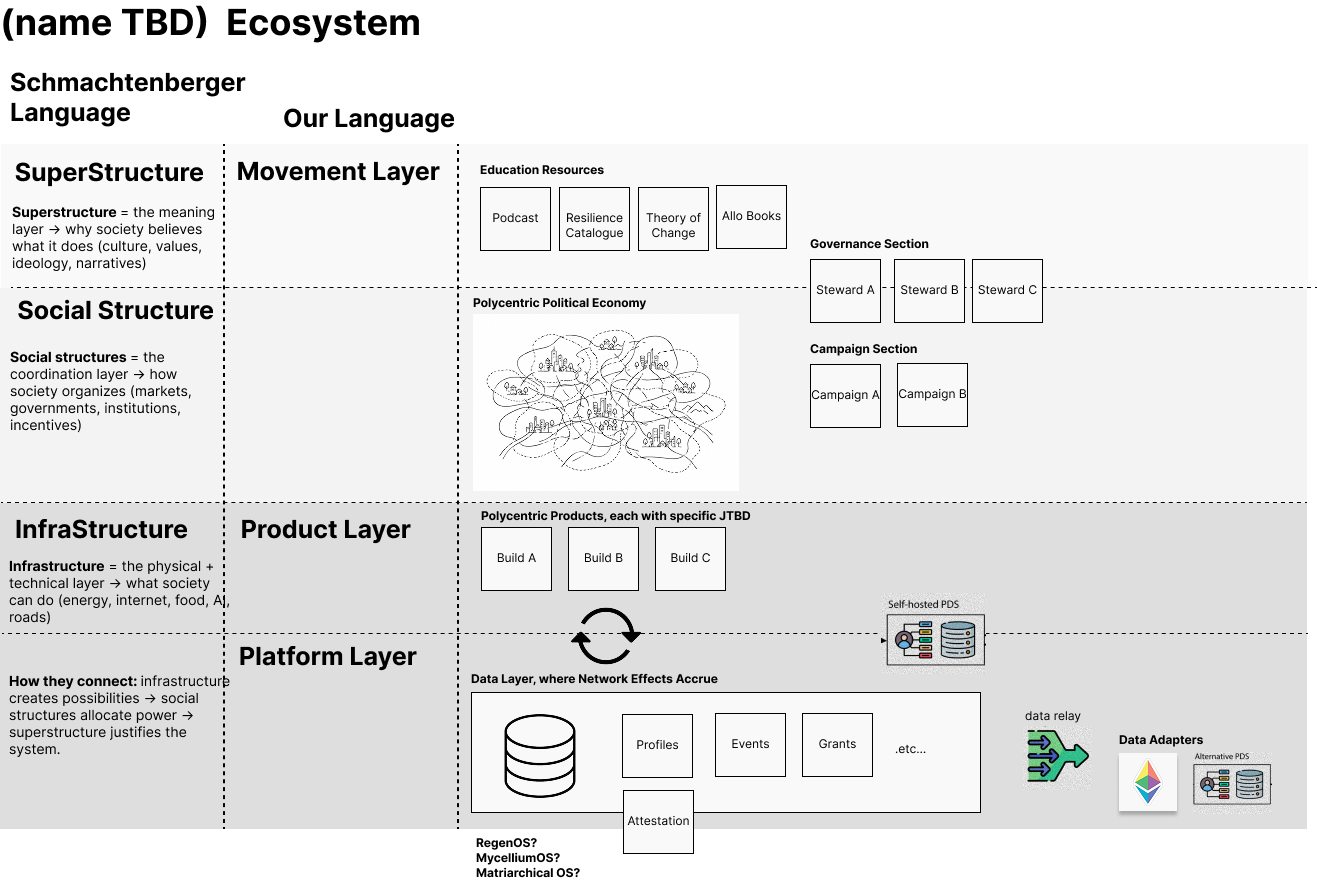
Monthly updates:
- [June 2026] Gitcoin Reboot Update - Funding What Matters in the Age of AI
- [July 2026] Gitcoin Reboot Update - The First-Principles Theory of Change
The First-Principles Theory of Change
TLDR
- Build a local-first platform that helps AI-displaced professionals move from isolation into trusted, real-world communities that provide jobs, mutual aid, and eventually civic power.
- Start with a focused [first_city] pilot centered on high-quality local opportunities and measurable offline actions, validating that the product can change behavior rather than just provide information.
- Scale from successful local networks to city partnerships and eventually a federated movement that can challenge extractive platform monopolies while keeping wealth, governance, and data local.
1. The Change Goal
To move isolated, economically vulnerable individuals facing rapid technological displacement out of digital paralysis and into highly organized, resilient, federated real-world networks.
These local networks will possess the collective economic weight, shared care infrastructure, and data sovereignty necessary to out-compete and permanently replace extractive corporate network monopolies.
The Human Metric (The 38-Year-Old Marketing Manager)
- Before: A 38-year-old marketing manager gets laid off because an AI model does her job for $20 a month. She owns no equity in the infrastructure of her life, her social interaction runs through platforms that profit from her isolation, and she has no connection to local governance. She is entirely exposed economically, psychologically, and politically.
- After: She controls a stable local income through a peer-vetted local workflow a robot cannot cheaply replicate. Her community consists of face-to-face relationships anchored in physical third spaces. She is actively organized within local municipal politics where her participation shifts real outcomes. The monopolies have shrunk in her life, and her personal agency has scaled.
2. The Problem Assessment (The Behavioral and Structural Crisis)
The Macro-Threat
Centralized network monopolies are aggressively automating labor, devaluing professional human expertise, and extracting local wealth into detached corporate capitals.
The core problem is not that AI is taking human jobs. Job displacement is a late-stage symptom of a deeper historical disease: the unchecked rise of the network monopoly. The internet did not decentralize society; it virtualized reality and engineered winner-take-all dynamics where a handful of platforms captured the global epistemic commons, retail markets, and social squares. AI accelerates this concentration by moving the middle class from employment to systemic displacement, handing control over labor, media, and governance to the entities that own the models.
You cannot reskill your way out of this trap. Even a perfectly retrained worker remains a digital hostage in a society run by a three-platform monopoly. The job is downstream of the monopoly, meaning a theory of change that only addresses jobs is solving at the wrong altitude. This structural capture directly drives our four core systemic harms.
The Micro-Crisis
The lived human experience of this technological transition manifests as an acute psychological and socio-economic crisis, mapping to our four core systemic harms:
- Skill Erasure and Cognitive Displacement: Creative and knowledge-class professionals are watching their specialized domains contract overnight. They face a bleak, shrinking market where their hard-won human expertise feels increasingly devalued, leaving them with a profound loss of personal agency.
- Relational Atrophy and Deep Isolation: Automated systems replace genuine human interaction with sterile, screen-mediated alternatives. Individuals are retreating into lonely digital silos, suffering from severe anxiety, and becoming socially brittle.
- Truth Collapse and Synthetic Noise: The internet has become an unnavigable dump of ghost jobs, fake listings, algorithmic clutter, and AI wrappers that simulate value while actively burning user attention.
- Systemic Monopoly Extraction: Local capital, regional data, and human labor are being aggressively harvested by top-heavy corporate platforms, leaving regional economies hollowed out.
The Failure of Current Alternatives
Existing digital tools are unequipped to solve this crisis because they are built on the wrong incentives:
- LinkedIn and Indeed: Broken corporate wrappers that trap desperate users in high-friction feedback loops filled with ghost listings, automated rejection templates, and predatory filters that treat human beings as commoditized data points.
- Reddit and Anonymous Forums: Useful for crowdsourcing raw information, but incapable of triggering actual behavioral change. They keep users stuck behind a screen, doomscrolling through anonymous, high-noise echo chambers without verified reputation or real-world accountability.
- Facebook Groups and Nextdoor: Built on an extractive ad-revenue model engineered to monetize outrage and maximize screen addiction. Their interfaces are optimized for passive consumption, making them fundamentally unsuited for mobilizing trusted offline action.
- The Infrastructure Paradox: Beautiful physical community infrastructure (modern libraries, maker spaces, civic centers) frequently sits empty and underutilized, because digital isolation has atrophied our cultural skillset and social muscles. People no longer know how to naturally navigate vulnerability, ask their neighbors for help, or coordinate mutual reliance.
3. The Solution Criteria
To succeed where other civic platforms have deflated, the platform must abide by seven unyielding design constraints:
- Local-First Architecture: The local node is the primary unit of the system; the global layer exists only to coordinate, never to aggregate. Data, decision rights, and economic value default to the neighborhood and degrade gracefully without the center: a city node that loses the platform tomorrow should keep its data, its relationships, and its working coordination habits. This is the structural inverse of the network monopolies we are countering, which centralize value and leave localities with nothing when the platform pivots.
- Online Improves Offline: Screen time is a cost, never the product. Every digital interaction must leave the user’s offline life measurably better: a gig found, a neighbor met, a space claimed: and the interface is judged by how quickly it gets the user back into the physical world, not how long it holds them. This is the explicit rejection of engagement-optimized product physics (Nextdoor, Facebook Groups), and it is what makes our metrics framework coherent: we count completed real-world outcomes, not session minutes.
- Close the Behavioral Gap, not just the Information Gap: The tool must not become an empty directory. It must explicitly teach and scaffold the social skillsets required to comfortably ask for help and offer support, guiding users through the psychological friction of offline vulnerability. Every feature must function as an explicit routing mechanism that drives an online action into an offline, real-world behavioral result.
- Leverage the Shared Demography of Shared Pain: Onboarding must anchor to a clear, high-pain demographic context and a tangible physical space, or to an intense, hyper-specific trigger event: “My contract pipeline just dried up, my company downsized, my industry is contracting: now what?” Shared precarity is the initial trust adhesive that aggregates capable, unmoored professionals, stabilizes their immediate crisis, and lets them phase into collective action.
- Incentivize Asking for Support: The software must use explicit UX patterns (reputation tracking, mutual aid accounting, local vouching) to lower the psychological barrier to asking for help, turning community building from an awkward chore into an organic survival utility.
- Enforce Strict Anti-Capture Architecture: The protocol must structurally guarantee that data, governance, and capital remain locked within the local participant nodes. We explicitly reject ad networks and data-brokering, ensuring the network can never be sold out to corporate or token-based monopolies.
- Execute Within Strict Bear Market Constraints: It must be deliverable by the core team within the capital position defined in the Financial Runway Model, using the matching pool as a strategic lever to pull in outside capital, and remaining focused on a single a-priori bet rather than a diluted portfolio of loose empirical guesses.
4. The Path to Solution (The Three-Track Evolution)
- Track 1: Acute Pain Resolution (The Virtual Entry Node): We launch a hyper-focused digital utility engineered to catch individuals at their moment of peak specific disruption. It answers one time-sensitive question: “How do I navigate my next 7 days?” For the jobs layer, it routes them directly to local gigs, immediate bridge work, and physical learning spaces.
- Track 1.5: The Behavioral Bridge (From Utility to Activation): The vital phase where stabilized individuals transition from isolated resource access into novel, cooperative behaviors. Having found immediate survival relief, users begin clustering into peer-vetted local pods, shared-tool cooperatives, and neighborhood working groups, actively rebuilding the cultural habits of mutual care.
- Track 2: Federated Network Governance: Once local pods achieve stability, the platform layers on decentralized governance protocols. Independent regional nodes are pooled into a vertical civic alliance capable of dictating terms to network monopolies and securing tangible policy wins: via the Municipal Sequence defined in the Scaling Blueprint below.
5. Problem/Solution-Space Background
Historically, movements fail to bridge the chasm from individual resource access to novel, collective behaviors. They either launch as top-down political sites that feel like homework, or as isolated, hyper-local mutual-aid groups that lack the macro-technological infrastructure to compete with the sheer convenience and network effects of Amazon or Uber. [newproduct] leverages global platform scale to coordinate hyper-local, decentralized execution: matching the efficiency of centralized tech monopolies while keeping wealth and agency localized.
Initial vs. Longer-Term Offering
The Initial Beachhead (Node Zero: [first_city])
We are not burning capital guessing at features across dozens of scattered markets. We are launching locally in a single, high-signal geography: [first_city]. This location provides a high density of highly capable, unmoored knowledge professionals navigating a visible breakdown of the local socio-economic contract. Launching in our own backyard allows for tight, real-time feedback loops to iron out product friction and rigorously prove our core traction metric: the Binary Action Gate (X% of onboarded users take 1 verified local IRL action within one week of onboarding; denominator threshold [decide on %age w team]).
The Strategic Scaling Blueprint
1. Geographical Scaling Hurdles and Considerations
Moving beyond Node Zero requires solving massive, real-world operational friction points:
- Demographic and Political Heterogeneity: The platform must adjust to vastly different regional trust profiles and political climates without alienating local participants.
- The Data Death Trap: The single greatest threat to local routing tools is bad, dying, or high-maintenance data. To avoid the classic “launch versus stewardship” pitfall where information rots after the initial hype fades, we will not rely on centralized web scraping. Data freshness is maintained through paid stewardship first, layered with decentralized worker-to-worker vetting and automated peer-curation incentives.
- Local Trust Architecture: We must respect existing regional power dynamics by partnering with, rather than disenfranchising, embedded community-based organizations.
2. The Jobs to be Done (JTBD) Expansion Pipeline
Choosing which module, vertical, or layer to build first requires us to recognize that asking “for whom we are building” is functionally identical to asking “what we are building.”
Demographic Sequence: The Influential Wedge Strategy
Our deliberate entry choice is the Unmoored Working Professional class. This segment possesses the cultural leverage, digital literacy, and immediate financial runway required to adopt the platform quickly, creating a referenceable win and generating rapid organic traffic. This is a trickle-down strategy of product effectiveness: we capture an influential, highly capable user group first to build a robust economic baseline and iron out operational kinks within a stable environment.
As [newproduct] expands beyond this initial wedge into lower-income and vulnerable communities, the foundational Jobs to be Done shift dramatically. The platform’s code must adapt to reflect these distinct economic realities.
Category Sequence
To achieve true product-market fit, [newproduct] rejects arbitrary feature-scoping and instead stress-tests every potential user segment and vertical against a strict, seven-point criteria matrix:
- ETHICAL
- 1. Do No Harm: Is it nearly impossible to name local community-based organizations that would be disenfranchised by our product’s entry?
- 2. Network Monopolies: Is it highly apparent which corporate network monopoly will be actively disenfranchised by our success?
- DESIRABLE
- 3. Pain Point and Outcome: Can we clearly name the user’s specific problem and define exactly what counts as a valuable, life-stabilizing outcome?
- 4. Trigger Event: Can we pinpoint the exact preceding event that makes a person a target segment (“You just [event], now what?”)?
- 5. High Pain and Unmet Needs: Is there clear, loud evidence of people complaining, angry, and deeply hurt by the existing corporate workarounds?
- FEASIBLE
- 6. IRL Opportunities: Can we easily find dozens of underutilized local, real-world solutions to send them to right now?
- 7. Missiony Brand: Is it intuitive for a layperson to mentally connect this segment to clustering around civic issues and rebuilding society?
Running our potential operational verticals through this stress test:
- Childcare: Weak on 1 (Do No Harm) and 6 (IRL Opportunities): risks disrupting existing informal care setups and lacks clear physical routing destinations. Tests strong on 3, 5, and 7.
- Food: Weak on 1 (regional group disruptions) and 4 (a clear, urgent personal trigger is hard to isolate). Strong on 5 and 7 due to rising systemic costs and community-health connection.
- Connection
- Dating, Friendship
- Events: Weak on 2 (competition too varied to challenge a single monopoly), 4, 5, and 7 (no urgent forcing function). Strong on 6 given the abundance of underutilized civic spaces.
- Learning
- Pleasure
- Meaning/Contribution
- Commerce: Weak on 1 in some areas, weak on 2, 4, and 5 (habits locked into convenience models). Strong on 6 via brick-and-mortar storefronts.
- Jobs: Our definitive, high-signal wedge: strong on 1, 2, 3, 4, 5, and 7. Weak on 6 only if we lazily build a standard corporate job board; remarkably strong on 6 when positioned as an infrastructure utility designed to “get stable and rebuild.”
- Capital Allocation/Funding
- Security
- Prepper type activities
3. From Utility to Social Change: The Municipal Sequence (and the Coalition of Mayors as Far-Horizon Hypothesis)
The long-term realization of our theory of change bridges individual survival and structural political power by treating [newproduct] as a digital-to-physical union for local labor and economic resilience. The strategic logic is: while national media keeps the public obsessed with the presidency, the arena where citizens hold real, decisive leverage is municipal. Mayors bear the direct, physical brunt of technological shocks; they cannot hide behind federal gridlock when local tax bases collapse and workforce sectors break down in real time.
A coalition of mayors does not emerge from app adoption; it is built through a staged sequence, modeled on the one civic platform that actually achieved municipal scale. Each stage has an exit criterion, and the next stage is not narrated externally until the prior one is met:
| Stage | What must happen | Exit criterion |
|---|---|---|
| 1. Resident density | Node Zero ([first_city]) reaches an active, retained user base taking verified IRL actions | T1/T2 behavioral gates met |
| 2. Documented local wins | Platform-organized residents produce concrete hyper-local outcomes (a reopened space, a gig pipeline, a neighborhood program) | Month-12 gate: one documented policy or municipal outcome traceable to platform users |
| 3. Formal city partnership | [first_city] city government becomes a named partner or customer of the coordination layer, riding the documented wins | Signed partnership or pilot agreement with product-control guarantees |
| 4. Replication | The recipe federates to 2–3 cities meeting the pilot-city hyperparameters (professional density + visible social-contract breakdown) | Stages 1–3 repeated in at least one non-[first_city] city |
| 5. Coalition | City executives with working deployments aggregate into a bloc with shared policy asks | Far-horizon; gated on all prior stages |
Two postures follow from this sequence. Externally, to funders: stages 1–3 are the deliverables; stages 4–5 are direction. Internally and to users: there is an open decision on what is transparent in onboarding from day one: is “Coalition of Mayors” a legible, imaginable north star that tells users why they are joining and makes progress feel reasonable (“rebuild where you are”)?. Or is it something that emerges over time. When the coalition does aggregate, the federal dynamic inverts: a coordinated bloc of municipal executives who control the country’s real-world economic engines is a counter-power the national layer is structurally forced to engage. That remains the destination: it is now a destination with a road.
4. The Product Success Metrics Framework
To ensure [newproduct] is closing a behavioral gap rather than gathering vanity traffic, performance is evaluated against 24-month progression as the spine, with every near-term metric carrying a denominator, a threshold, an owner, and a consequence.
The Long-Term North Star (The Macro Vision)
Systemic stabilization of the community: measurable increases in economic security, reduced isolation, higher reported individual happiness, and reliable local networks of care, making the neighborhood structurally more resilient to technological and economic shocks. These mature on a multi-year horizon and are tracked, not gated.
The 24-Month Progression
| Horizon | Question | Gate (Structure; Thresholds [SET WITH BOARD]) |
|---|---|---|
| Month 3 | Can isolated individuals solve their next 7 days? | X% of onboarded users take 1 verified local IRL action within 7 days of onboarding |
| Month 6 | Are participants clustering into issues? | X% of stabilized users take a second IRL action within 60 days of their first; x%age peer pods/cohorts formed and active |
| Month 12 | Are we solving local problems? | X documented local policy or municipal outcome traceable to platform-organized residents |
| Month 24 | Are we a shared governance layer? | Stage 3+ of the Municipal Sequence underway in [first_city]; replication criteria defined |
The Proximate Performance Metrics (Node Zero, Tracked Weekly/Monthly)
Input hypothesis
- Information Uniqueness (Measured, Not Self-Reported): Replace the self-report “uniqueness score” with a blind comparison task: a sample of target users is given the same local need (find bridge work, find a learning space) on [newproduct] and on their incumbent alternative (LinkedIn, the local subreddit, an LLM), and we measure task success rate, time-to-useful-result, and stated preference. Run monthly on a rotating panel. If [newproduct] does not beat the incumbent toolkit on this task, the data layer has not earned existence: regardless of how warm our own users’ survey answers are.
- Data Freshness SLA: X% of active listings verified fresh within 14 days, per category, per the M1 defense metric. Two consecutive misses halt growth spend. Owner: Lucian (pipeline) + Leah (standard).
outputs
- Real-Life Relationship Generation Rate: Conversion of sign-ups into verified physical interactions, with the denominator being all onboarded users in the cohort: not active users, which hides churn.
- Organic Referral Velocity (Primary Growth Signal): Invitations sent and accepted per active member per month. People only pull trusted peers into their coordination circles when the tool clearly works; this is the hardest-to-fake utility signal we have.
- NPS (Diagnostic, Not Primary): Retained as an ongoing diagnostic for interface friction. Demoted from headline status: on a pilot-sized population NPS is statistically noisy and structurally flattering, and no expansion decision should rest on it.
7. Our Unique Execution Edges
The competitive seat we occupy is specific, and it is worth stating it precisely rather than grandly. Adjacent players exist on every side: Nextdoor owns the local graph, workforce boards and outplacement firms own displacement services, mutual-aid networks own the solidarity ethos, and LLMs increasingly own the advice layer. What nobody occupies is the combination: a hyper-local, do-this-today utility for the displaced professional that routes to verified offline action and is backed by a proven capital-allocation engine. The claim is the intersection, not the empty field: and the Evidence Review (Cases 6–8) documents why each adjacent player is structurally unlikely to converge on it.
Our Unfair Advantages:
- A Proven Allocation Primitive: Gitcoin’s Quadratic Funding mechanism is a battle-tested public goods engine that has programmatically moved nine figures. This is an operational capability, not a hypothesis: and it is the capability the coalition model monetizes.
- Capital Independence on a Clock: A liquid treasury and matching pool (figures and runway scenarios per the Financial Runway Model) providing multi-year operational independence and a 1:1 de-risking wedge for outside capital. Stated honestly: this is runway, not validation: the ~$50bn of aligned funding referenced in the economic memo is an unvalidated demand signal, and converting it into a signed lead funder is the near-term objective, not an existing asset.
- Market-Facing Product Leadership: Leah Lykins (PM) has built operational jobs platforms including SkillUp and owns the consumer surface: the structural counterweight to the team’s crypto-native product instincts.
- High-Signal Leadership Network: An established founder ecosystem with demonstrated ability to enroll public-goods-oriented builders, engineers, and regional organizers, plus active advisory engagement from top-tier systems thinkers.
The Pre-emptive Red-Team Exercise
Organized in three tiers. A red team that only stress-tests execution implicitly assumes the strategy is sound: the assumption that most needs attacking.
- Thesis Failures: The strategy itself is fundamentally wrong, even if executed perfectly.
- Model Failures: The strategy is correct, but the underlying economics or product mechanisms fail to close.
- Execution Failures: The strategy and model are sound, but the team fumbles the practical delivery.
Failure Mode Index
| ID | Failure Mode | Category |
|---|---|---|
| T1 | The V1 to V2 chasm is unbridgeable | Thesis |
| T2 | Software cannot close the behavioral gap | Thesis |
| T3 | The Coalition of Mayors has no clear mechanism | Thesis |
| M1 | The data death spiral | Model |
| M2 | The fundraising target never converts | Model |
| M3 | Crypto association repels both users and institutional funders | Model/Execution |
| E1 | The capital formation seat remains empty | Execution |
| E2 | Executive attention fragmentation halts progress | Execution |
| E3 | Mechanism fetish: building for ourselves instead of the user | Execution |
| E4 | The socio-economic translation gap isolates the product | Execution |
Thesis Tier
T1. The V1 to V2 Chasm Is Unbridgeable
- The Core Failure: Users arrive in a crisis, extract immediate utility (find a quick gig, navigate their next seven days), and leave. Retention tanks the second their acute problem goes away. The platform becomes a transactional job board dressed up in movement language, leaving Track 2 with zero participants because Track 1 graduates do not stick around. This is the core load-bearing assumption of our entire strategy. No platform, including every example in our own evidence review, has ever successfully converted short-term survival utility into durable civic participation at scale. Leah flagged this as the absolute hardest leap.
- The Hardened Strategy: Build re-engagement into the core product surface from day one rather than hoping it happens.
- (a) Form peer pods with mutual obligations during the crisis phase, not after it: users stick around for people, not features.
- (b) Run an alumni-as-curator loop: users who get help become data stewards for the next person, turning baseline gratitude into a functional role.
- (c) Script the identity shift explicitly inside the app, moving users from “I need help” to “I am a node.”
- (d) Instrument the 24-month metric progression immediately, ensuring the Month-6 cohort review has clean data to see if users are actually clustering into local issues.
- The Defense Metric: If fewer than X% of stabilized users take a second IRL action within 60 days of their first by Month 6 of Node Zero [SET WITH TEAM], the Track 2 assumptions are dead. The board must then choose between re-scoping to a pure utility with a different economic engine, or shutting down. Owner: Leah. Cadence: monthly cohort report.
T2. Software Cannot Close the Behavioral Gap
- The Core Failure: Our own “Infrastructure Paradox” states that the social muscles for offline vulnerability have atrophied. The bet that UX scaffolding (templates, prompts, and permission architectures) can rebuild those muscles is our biggest leap of faith. If we’re wrong, people pull data and never touch the real world. We become just another directory, which explicitly violates our core solution criteria. The historical track record is brutal: Meetup, Facebook Events, and Nextdoor only route online-to-offline at the absolute margins, failing to change underlying behavior. The only partial exception, Buy Nothing, relied on pre-existing Facebook social graphs and a single, low-friction reciprocal behavior, not complex civic coordination.
- The Hardened Strategy:
- (a) Shrink the first requested behavior to Buy Nothing-level simplicity: one action, one object, one neighbor, rather than asking them to join a complex pod.
- (b) Do not rely strictly on software for the first thousand users. Budget local connectors as human scaffolding, treating their cost as R&D discovery instead of operations overhead.
- (c) Run each onboarding cohort as an explicit behavioral experiment with a clear conversion hypothesis.
- The Defense Metric: The binary IRL action gate needs a denominator: X% of onboarded users must take one local IRL action within 7 days, tracked weekly [SET WITH TEAM]. A gate without a denominator cannot fail, and a metric that cannot fail is useless.
T3. The Coalition of Mayors Has No Mechanism
- The Core Failure: There is a massive void between “the [first_city] pilot works” and “a national coalition of municipal executives.” There is no product feature, clear incentive, organizing pathway, or logical sequence connecting them. Mayors join coalitions for electoral or fiscal leverage; a few thousand app users in [first_city] provides neither. Left unchanged, this goal operates as internal mythology that warps product choices and looks like fantasy to institutional funders. It fails the very standard we apply to others: a claim without an explicit mechanism.
- The Hardened Strategy:
- (a) Reframe the Coalition of Mayors as a far-horizon hypothesis with its own gating criteria. Keep it in user-facing storytelling for transparency, but strip it out of near-term investor deliverables.
- (b) Replace the missing pathway with the Municipal Sequence (see Scaling Blueprint §3), modeled on the Decidim precedent: capture resident density, document hyper-local wins, establish a formal city partnership in [first_city], replicate, and only then build the coalition. The city must be a functional partner before mayors become a movement.
- (c) Task Taylor with pressure-testing the municipal sequence.
- The Defense Metric: By Month 12, achieve one documented local policy or municipal outcome directly tied to platform-organized residents. If missing, rewrite the narrative before repeating it externally. Owner: Kevin. Checked at the 18-month hard gate.
Model Tier
M1. The Data Death Spiral
- The Core Failure: If peer-curation incentives lag, listings rot by week six. A user checks the platform three times, finds stale data, and retreats to Reddit or an LLM. Word of mouth quickly flips from a growth engine to a warning. This kills the platform before we can even test our behavioral hypotheses; it is entirely upstream of T1 and T2.
- The Hardened Strategy: * (a) Use paid curation to bootstrap the system. Budget professional data stewardship for the first two quarters of Node Zero rather than assuming volunteer vetting will work from day one. Layer decentralized worker-to-worker verification on top of a maintained baseline, not instead of one.
- (b) Establish a strict data freshness SLA per category (gigs, spaces, groups, events), each with a named owner.
- (c) Treat data operations as a budgeted line item in the runway model, not as an emergent community behavior.
- The Defense Metric: Ensure X% of active listings are verified fresh within the last 14 days [SET WITH TEAM]. Two consecutive months below this threshold automatically halts growth marketing spend until resolved, escalating to the board on the third month. Owner: Lucian (pipeline) + Leah (standards).
M2. The Funding Target Never Converts
- The Core Failure: We experience twelve months of warm, high-quality meetings and “very interested” responses, but land zero signed commitments. This is the most common failure pattern in mission-capital formation: enthusiasm is free, allocation is not. Meanwhile, the matching pool burns on a faster clock than our opex runway, meaning external capital is required by roughly Q1 2027 at an aggressive deployment pace. The risk is compounded if our materials alternate between treating this capital as a locked asset and an unvalidated signal; pitching the optimistic version invites a diligence failure with the exact institutional funders we need.
- The Hardened Strategy: * (a) Maintain one consistent posture everywhere: this is an unvalidated signal, and validating it is our Phase 0/1 objective (adopted in the Reader’s Note).
- (b) Convert the signal into 3 to 5 named funders with the executive team. Conversations with fundraising leads are actively underway as of June 2026.
- (c) Define validation strictly as a signed LOI or commitment, never a meeting count.
- (d) Let the economic memo’s green-light gates govern: secure a lead funder at 8 figures by the December 2026 board meeting, or activate the wind-down branch.
- The Defense Metric: The economic memo’s hard gates 1 through 4 (lead funder, coalition roster, fee revenue clearing operations, and a provable efficiency claim) govern this risk.
M3. The Crypto Association Repels Both Sides
- The Core Failure: This is a two-front brand risk that previous iterations only addressed halfway. First, our wedge demographic of displaced professionals, who are deeply skeptical of crypto headlines, look up the team, discover token histories and treasury mechanics, and abandon the app before taking their first action. Second, a legacy foundation’s diligence team flags token exposure, GTC buyback mechanics, and regulatory ambiguity, then quietly passes. Legal ring-fencing only solved the fundraising problem; the user-trust gap remains unaddressed without brand separation.
- The Hardened Strategy:
- (a) Enforce complete brand separation at the consumer surface: no tokens, no web3 vocabulary, and no co-branding anywhere a Node Zero user can see.
- (b) Accelerate the planned ring-fenced 501c3 path so the funder-facing entity is structurally clean, not just narratively clean.
- (c) Message-test the brand with target users before launch (managed by Leah) including direct probes for crypto-association trust friction.
- The Defense Metric: In pre-launch and onboarding research, if more than X% of target users surface crypto-related distrust unprompted [SET WITH TEAM], the brand separation is ruled insufficient and launch messaging is completely reworked before deploying capital.
Execution Tier
E1. The Capital Formation Seat Stays Empty
- The Core Failure: We face capital starvation if the dedicated fundraising lead is not secured before our runway runs thin, a risk worsened by a weak historical hiring track record and a tendency to recruit from insular networks.
- The Hardened Strategy: Retain an outside executive search firm to place a proven Capital Formation Lead with deep legacy family-office and tech-philanthropy relationships. Keep the nonprofit vehicle entirely clean of token exposure with legally isolated accounts. Status Update (June 2026): Active conversations with fundraising leads are underway; the metric trigger below remains in force until a signature is secured, not just a conversation.
- The Defense Metric: No signed, active Capital Formation Lead within 60 days freezes further long-term matching pool allocations.
E2. Executive Attention Fragmentation
- The Core Failure: Engineering velocity freezes when leadership attention fragments into side projects, ecosystem politics, and elaborate proposals for external organizations that ultimately reject the mandate within weeks.
- The Hardened Strategy: Enforce strict role specialization. The original defense metric of auto-terminating any meeting spending more than 15% of its time off-sprint has been removed. It is unenforceable, and empty rules only undermine the credibility of the real ones.
- The Defense Metric (Revised): Two clear, enforceable rules:
- (a) No project or initiative receives core team meeting time without a named owner and a written, measurable goal submitted in advance.
- (b) All product decisions on the consumer surface are strictly gated by the product owner (Leah). Items without her explicit sign-off cannot enter a sprint. Audit this via a five-minute review of written sprint goals at each retrospective.
E3. Mechanism Fetish: Building for Ourselves
- The Core Failure: The [first_city] product group defaults to crypto-native mechanism design (governance primitives, token loops, and complex allocation mechanics) out of sheer habit, not market demand. Product calls optimize for what is interesting to engineer rather than what a displaced 41-year-old project manager actually needs on a Monday morning. This is the deeper version of our identified “Lazy UX” weakness: it is insular product theology. The warning sign is simple: if a product discussion cannot explicitly name the target user, the trigger event, and direct behavioral evidence, it is a mechanism debate wearing a product costume. This failure is existential, not cosmetic. Winning requires out-competing LinkedIn, Reddit, and LLMs for a mainstream user’s attention, an asymmetric contest that a mechanism-first product will lose every time.
- The Hardened Strategy:
- (a) Leah holds final product authority over the consumer surface; her track record building operational jobs platforms is the practical counterweight the team requires.
- (b) Every single feature ticket must explicitly name the user, the trigger event, and the direct evidence (interview quotes, support signals, observed behavior) before it is allowed into a sprint.
- (c) Complex mechanism work is strictly quarantined to a Track 2 R&D backlog and cannot displace Track 1 execution.
- (d) Founders participate in product calls as structural input, not a unilateral veto.
- The Defense Metric: Quarterly feature audit tracking the percentage of shipped consumer features traceable to direct user evidence versus internal mechanism hypotheses [threshold SET WITH TEAM]. Falling below the threshold automatically tightens sprint intake rules and escalates the audit to the board.
E4. The Socio-Economic Translation Gap
- The Core Failure: The beachhead tool fails to translate beyond affluent professionals without dedicated adaptation R&D, leaving us with an insulated tool for a privileged class.
- The Hardened Strategy: The 60% comprehension and utility milestone must be met via localized user testing before any new demographic rollout is approved.
The Meta-Failure Mode: We Become Case 5 in Our Own Graveyard
The most honest exercise for this red team is tracking which failure archetype from our own evidence review we are currently trending toward.
- The EveryBlock Risk: We become an engaged community with no independent economics, surviving entirely at a patron’s pleasure and shut down the day strategic priorities shift. Our internal treasury is our corporate backer.
- The Pandemic Mutual-Aid Hub Risk: We generate raw coordination energy that quickly dissipates the moment the acute crisis fades and core organizers burn out.
Strategic Inquiry for the Board: The board must answer a single question each quarter: Which archetype did we drift toward in the last 90 days, and what explicit changes did we make because we caught it?
Gitcoin Executing [newproduct]: SWOT Analysis
Strengths (Internal Advantages)
- Battle-Tested Funding Primitives: A proven historical track record in building, scaling, and successfully executing Quadratic Funding platforms that have programmatically moved nine figures.
- Capital Independence: Access to a liquid treasury and matching pool (figures per the Financial Runway Model) providing multi-quarter operational runway and insulating the project from short-term market volatility.
- High-Knowledge Advisor Network: An elite ecosystem of deeply integrated, authoritative advisors across political science, systemics, and tech architecture.
- Immediate SME Pull: Active, high-velocity interest from top-tier Subject Matter Experts who are aggressively looking to engage with us to execute their theoretical frameworks.
- Market-Facing Product Leadership: Leah Lykins (PM, ex-jobs-platform builder incl. SkillUp) owning the consumer surface.
Weaknesses (Internal Vulnerabilities)
- The Incumbent Benchmark Trap: Our actual competition consists of hyper-scaled platforms with multi-billion dollar user acquisition moats. To win, the interface must prove to the user that it is definitively more useful than established habits like Reddit, LinkedIn, or simply talking to an LLM.
- The Lazy UX Default: The current product team over-prioritizes the “vibe” of agentic coding and rapid automated building. This creates a dangerous tendency to underestimate the necessity of high-touch, human-centric product design, risking a reliance on lazy, out-of-the-box LLM user experiences that cannot compete with platforms featuring billion-dollar UX budgets. (Stress-tested as failure mode E3.)
- The Wrong Wedge Vulnerability: High statistical risk of selecting the incorrect initial beachhead across our three launch variables: the wrong geography, the wrong primary Job to be Done, or the wrong demographic target audience.
- Founder Attention Fragmentation: A weak track record in rigorous talent acquisition and structured team building, leaving the core lines vulnerable to distraction from side projects or non-essential ecosystem politics. (Stress-tested as failure modes E1/E2.)
- Strategic Proposal Deadlocks: Getting drawn into spending weeks creating massive operational proposals for external groups that ultimately reject or ignore the mandate within a two-week window.
- The Junior Execution Bottleneck: Trapping the operational lines by placing junior skill sets into highly senior, macro-organizational design roles.
Opportunities (External Market Shifts)
- The In-Person Behavioral Premium: A profound cultural shift where people genuinely prefer face-to-face interaction. The physical, real-world solutions we route people toward fundamentally feel good, causing users to actively prefer our offline destination over on-screen alternatives.
- Systemic Technology Fatigue: A growing, legitimate consumer sentiment where individuals feel exhausted and degraded by their daily interactions with extractive technology, creating a massive addressable market of users actively hunting for structural alternatives.
- The “Ghost Job” Market Window: Widespread public anger at legacy career platforms due to algorithmic noise, data harvesting, and fake listings.
Threats (External Hazards)
- The Monopoly Megaphone: Extractive network monopolies possess control over the dominant media channels and can drown out or algorithmically suppress our platform’s messaging.
- The Fundraising Vacuum: A brutal, prolonged bear market that dries up traditional philanthropic allocations before our fiat capital pipelines are fully established.
Evidence Review
Each case is verified with sources, states the lesson honestly (including where the evidence cuts against us), and includes the comparables closest to what we are building. This is the same three-way vetting standard (product / theory of change / business) we intend to apply to others, applied to ourselves first.
Case 1: EveryBlock
- What Actually Happened: Founded in 2007 by Adrian Holovaty with a $1.1M Knight Foundation grant; acquired by MSNBC.com in 2009; shut down abruptly by NBC News in February 2013. NBC cited “increasing challenges to building a profitable business” and stated the site “wasn’t a strategic fit” while describing losses as considerable (WBEZ, CNN, TechCrunch, Feb 2013).
- The Corrected Lesson: The assumption that EveryBlock decayed into low-value notification spaces and lost user retention is false. It maintained an engaged, loyal community to the very end, as evidenced by hundreds of user comments on the farewell post. It died because it had no independent economics and lived entirely at a patron’s pleasure. The warning to us: a treasury-subsidized platform with engaged users will still die the moment the patron pivots. Our answer is the economic memo’s gate 3: fee revenue clearing lean operations on a strict timeline.
Case 2: Patch
- What Actually Happened: Under AOL, Patch blitzscaled to roughly 900 sites and lost $200M to $300M (NYT, 2014). AOL sold majority control to Hale Global in 2014. Under lean operations, Patch became profitable, generating roughly $20M in annual ad revenue across 1,200 communities with 110 journalists by 2019 (Recode, Digiday, AdExchanger). It remains operational today.
- The Corrected Lesson: Hyper-local information infrastructure is not structurally doomed; blitzscaled hyper-local is. The profitable version of Patch succeeded through beachhead-by-beachhead expansion, brutal cost discipline, and a willingness to serve communities thinly before scaling deeply. This directly supports our Node Zero, curate-not-operate posture, and argues strongly against multi-city expansion before unit economics are proven in a single node.
Case 3: Change.org, Avaaz, Global Citizen
- What Actually Happened: These platforms are alive, operating at scale, and generating revenue (Change.org operates as a B-corp). The accurate critique is not collapse; it is that they convert outrage into digital signatures without converting those signatures into material local outcomes.
- The Honest Lesson: Clicktivism proves that the engagement-to-material-outcome gap is real and brutal. This is the exact V1 to V2 chasm (Failure Mode T1) in a different form. These platforms are evidence that the chasm exists, not that our current design successfully crosses it. Citing them validates the problem, not our solution.
Case 4: Code for America Brigades
- What Actually Happened: In 2023, Code for America ended fiscal sponsorship of and sunset its Brigade program, cutting loose roughly 60 volunteer chapters to find independent fiscal sponsors and new names (StateScoop, Feb/May 2023; CfA’s own retrospective, Sept 2023). CfA concluded it was “not best suited to serve as a central supporting organization for a network of volunteers.”
- The Refined Lesson: This is not primarily a story about treating power asymmetries as UI bugs. It is the patron-risk lesson again, this time in nonprofit form: volunteer networks dependent on a central organization’s balance sheet and legal wrapper die when the center’s strategy shifts. For our model: local chapters must reach independent economics quickly, or our federated approach will recreate the exact dependency that killed the Brigades. (This is also why Local-First Architecture is a solution criterion, not a slogan.)
Case 5: Pandemic Mutual Aid Hubs (Claim Strength Corrected)
- What Actually Happened: Tracked Massachusetts mutual-aid groups fell from roughly 30 active groups down to a handful by fall 2020. This decline was driven by volunteer burnout, return-to-work mandates, and funding constraints, even though community need persisted (UMass Lowell sociologist Thomas Piñeros Shields, via CS Monitor, 2023). UK interview studies and broader disaster-solidarity literature document the exact same decline pattern. Conversely, the groups that persisted (such as Mutual Aid Eastie) did so precisely because they added formal structure and funding.
- The Honest Lesson: Pure altruism is a short-term shock absorber, not permanent infrastructure. The persistence of the structured, funded exceptions provides our direct design instructions.
Case 6: Nextdoor
- What Actually Happened: A verified-address local network with over 105M verified members across 350,000 neighborhoods, pulling roughly 21M weekly platform actives (declining 3% to 5% YoY through 2025). It generated $258M in FY2025 revenue but remains unprofitable, posting a net loss of $54M in FY2025 after well over a decade of operation and enormous capital injections (Nextdoor investor reports, Q3/Q4 2025).
- The Strategic Confrontation: A billion-dollar effort built on real identity and a local graph still produced mostly passive consumption, where crime and safety content remains the dominant engagement driver, without developing any economic-resilience layer. Our differentiation must directly answer why we aren’t just Nextdoor with a mission deck: Nextdoor monetizes attention through ads, so its product physics optimize for feed time; [newproduct] routes to offline action, meaning its product physics optimize for completed real-world outcomes. That is a fundamental structural difference, but it is a claim we have to prove through T2 behavioral gates rather than simply asserting it.
Case 7: Buy Nothing Project
- What Actually Happened: Founded in 2013 as standalone Facebook groups on Bainbridge Island, it scaled to millions of members worldwide (independent estimates track roughly 7.5M users; the organization claims 14M+) across 50+ countries: achieving exactly the digital-to-IRL, neighbor-to-neighbor behavior change at scale that we want, on pure altruism, with no paid staff for years (NPR 2018; buynothingproject.org). Its later trajectory is equally instructive: the founders’ attempt to monetize via a VC-backed mobile app met severe community backlash and poor product adoption (Marketplace, 2023), and 2025 trademark enforcement against its own volunteer groups triggered open user revolt (Gazetteer SF, Nov 2025).
- The Twin Lessons:
- (a) A single, dead-simple reciprocal behavior riding an existing social graph can scale offline behavior change with near-zero infrastructure overhead. This complicates our blanket claim that altruism cannot sustain infrastructure, setting a very high bar for how simple our first requested action must be (see Failure Mode T2).
- (b) Bolting an extractive economic layer onto an altruistic community after the fact destroys the underlying trust asset. Our economics must be present, legible, and fair from day one, never retrofitted.
Case 8: Decidim / Barcelona
- What Actually Happened: An open-source participatory democracy platform developed under Barcelona’s digital sovereignty agenda led by Francesca Bria. It has been adopted by hundreds of cities and institutions worldwide, remaining publicly governed and explicitly anti-capture.
- The Lesson: Municipal-grade civic software scales when the city functions as the customer or partner and adoption rides policy, not when citizen density alone is expected to magically summon political leadership. This is the precedent behind the Municipal Sequence (Scaling Blueprint §3 and Failure Mode T3): citizen density leads to documented local wins, which secures a formal city partnership in [first_city], enabling replication and the eventual creation of the coalition.
Case 9: Listings Project
- What Actually Happened: Founded in 2003 when artist Stephanie Diamond emailed friends for housing leads in New York; the list grew by word of mouth into a weekly compilation of real estate, studio, and job listings for artists and creatives. Today it is a 20+ year-old, independent, woman-owned Certified B Corp with a small team, over a million annual site visitors across 200 countries and 43 U.S. states. Every listing is personally vetted by a human — checked for accuracy and for discriminatory or biased language — with the team corresponding individually with each lister weekly. Revenue comes from lister posting fees (free for readers); no ads, no data sale, no venture capital; growth has been word-of-mouth only (listingsproject.com; StreetEasy interview, 2016)
- Where It Supports Us: (a) Hypothesis A has an existence proof: a zero-slop, human-vetted listings layer can beat the noise of incumbent platforms on trust, sustain itself economically, and hold a loyal community for two decades — the vetting standard is the moat. (b) It vindicates the Buy Nothing lesson: economics (lister fees) were present and legible from day one, never retrofitted, and the community accepted them. (c) Twenty years of word-of-mouth-only growth is direct support for Organic Referral Velocity as our primary growth signal. (d) The demographic — creatives navigating precarity — is adjacent to our wedge, evidence that shared identity plus shared pain is a real trust adhesive.
- Where It Cuts Against Us: (a) It is the V1→V2 chasm, embodied, for twenty years: despite genuine community branding, the product is a transactional utility — find a space, find a gig, done. Two decades and a million annual visitors produced no collective-action layer. If a beloved, values-driven listings service could not cross that chasm in 20 years, T1 is even harder than stated. (b) The vetting never decentralized: it stayed centralized, human, and paid — and that is why the data stayed clean. This supports M1’s paid-stewardship posture but challenges Hypothesis A’s iteration bet that worker-to-worker vetting can organically maintain freshness without centralized maintenance; paid curation may be a permanent cost, not a bootstrap phase. (c) Hand-vetting by a small team caps throughput: “thousands of people connected” over 20 years is the honest number. The model proves quality; it does not prove quality at the consumer-scale density per city that Track 2 requires. (d) It is a newsletter, not a platform, with near-zero engineering — which sharpens the Alternative A (allocator-only) question: if the highest-trust listings layer in existence is a hand-curated email, the consumer product must demonstrate what an app earns over a curated list. Node Zero should treat a Listings Project-grade curated digest as the minimum viable benchmark the product has to beat, not as a quaint predecessor.
Alternative Approaches
Legacy dispositions, condensed: Pure resilience/reskilling-only: rejected; it solves at the wrong altitude (the job is downstream of the monopoly). Pure federal resistance/antitrust-only: rejected; slow, captured, and megaphone-controlled, though its local form survives through the Municipal Sequence. The genuinely hard alternatives are steelmanned below, each with an explicit revisit condition.
A. Fund Existing Local Organizations Instead of Building Product (“Allocator-Only”)
- The Steelman: We possess a battle-tested, nine-figure allocation engine (QF), a $10M matching pool, and a forming funder network, but we have zero consumer-product track record against incumbents holding billion-dollar acquisition moats. The fastest, lowest-burn route to the change goal may be to skip building an app entirely. We could run coalitional funding rounds for existing mutual-aid organizations, workforce boards, and resilience hubs, using our framework purely as financial and administrative rails. The economic memo’s fee model already supports this path. It is the strongest alternative on the board.
- The Disposition: Not rejected; this represents the live strategic tension between the consumer-product build and the allocation-rails build. The current executive position as of June 2026 treats the consumer product as the core bet, with allocation rails operating as the revenue and coalition engine behind it. To maintain this posture, the Node Zero pilot must prove the consumer product earns its engineering complexity relative to this simpler allocation alternative. We do not default to allocator-only because pure financial allocation fails to close the behavioral gap (moving money to organizations is not the same as driving individuals to form new offline habits), fails to build the consumer-scale network Track 2 requires, and drifts back into the commoditized grant-tooling lane we explicitly exited.
- The Revisit Condition: If Node Zero misses its core behavioral gates (T1/T2) while our coalition funding rounds simultaneously show high dollar-to-edge efficiency results, the December 2026 team will consider re-weighting the product toward an allocator-only model. This is structured as a named branch, not a face-saving pivot.
F. Partner and Integrate Rather Than Greenfield
- The Steelman: Securing distribution through existing channels (labor unions, public library systems, municipal workforce centers, community colleges, or direct integration into an incumbent local network) completely sidesteps the user-acquisition moat. These partners already own the displaced-worker foot traffic; we simply supply the coordination and routing layer they lack.
- The Disposition: Rejected as a primary entry strategy. Relying on partners’ legacy systems and splitting UX control would gut the precise behavioral design that makes our platform necessary. Furthermore, institutional integration timelines are measured in years, a window we do not have. However, this is adopted as our core channel strategy: public libraries, workforce centers, and civic institutions will serve as first-class routing destinations and distribution partners in Node Zero. They host the offline endpoint; our software hosts the platform.
- The Revisit Condition: If Node Zero Customer Acquisition Cost (measured in dollars spent or steward-hours per activated user) exceeds the team-approved threshold [SET WITH TEAM] for two consecutive quarters, partnership-led distribution will be re-elevated to the primary strategy.
G. B2G-First: Sell to Cities, Reach Citizens Through Local Government
- The Steelman: This is the Decidim motion. Securing municipal adoption solves the cold-start network problem, gives Track 2 an immediate legal and structural mechanism, and generates reliable contract revenue. Mayors facing tax-base erosion are documented buyers of this exact category of community stabilization tools.
- The Disposition: Rejected as our entry strategy. Municipal procurement cycles of 12 to 24 months completely outrun our current runway window. Furthermore, a city-as-customer posture forces the product to optimize for incumbent political interests, risking capture by the exact dynamics we exist to counter, while the civic-tech implementation literature explicitly documents how slow government deployment grinds down early-stage tech teams. This is instead preserved as our Track 2 mechanism: once resident density and documented local wins give us standing in [first_city], the city partnership becomes Stage 3 of the Municipal Sequence, replacing the previously unspecified leap from a single pilot to a national coalition.
- The Revisit Condition: If a credible city executive extends a fully funded pilot offer with ironclad product-control guarantees before Node Zero completes, the board will evaluate the opportunity on its own operational merits rather than reflexively deferring to the sequence.
The Concrete Initial Offering Specification
1. The Target Segment
The Immediately Unmoored Working Professional class located exclusively within our Node Zero market of [first_city]. This includes tech workers, creatives, recruiters, designers, and operations specialists who are watching their traditional career pipelines evaporate and are hunting for immediate local stability. Per Leah’s framing: this includes industry contraction, severance ending, and the return-to-work wall: not only acute layoffs.
2. The Core Value Proposition
To provide a high-quality, platform + products that outperforms the noise of legacy platforms, combined with the transaction-focused UX patterns required to drive users to self-organize into highly resilient, real-world networks.
3. Cadence
quarterly sprints to
- stoke the movement
- stoke the platform nfx
- reinvent gitcoin governance/stewardship
until valhalla! or until we run out of money..
4. The Initial Product Architecture (Core Research & Iteration Questions)
A. The High-Signal Data Layer Hypothesis
- The Product Question: Can a peer-reviewed, zero-slop relational/regional registry of actual economic opportunities and bridge work provide a demonstrably more unique, helpful, and navigable interface than the overwhelming ghost posts on LinkedIn or the unnavigable information chaos of local subreddits?
- The Iteration Focus: We are testing decentralized, worker-to-worker vetting lines and local vouching protocols (ATProto specifically) to see if a hyper-local user node can organically maintain absolute data freshness without requiring centralized operational maintenance: bootstrapped by paid stewardship.
B. The Self-Organization Blueprint and Tooling Integration Hypothesis
- The Product Question: Can software successfully drive citizens to claim and utilize existing physical infrastructure (libraries, parks, third spaces) entirely on their own by providing turnkey structural templates instead of top-down event operations?
- The Iteration Focus: We are rapidly testing whether aggregating and vetting existing independent facilitated meetups, paired with lightweight integrations (such as an iMessage plugin or a more sovereign WhatsApp group alternative), can seamlessly convert casual, real-world text threads into structured, offline resource sharing and IRL gatherings.
C. The Behavioral Chasm Bridge Hypothesis
- The Product Question: Can a software interface function as a legitimate permission architecture that lowers the psychological barrier to offline mobilization within an isolated or socially brittle community?
- The Iteration Focus: We are experimenting with whether onboarding flow scaffolding and template-driven prompts can transform an uncomfortable social risk into a normal, everyday product action: empowering a user to comfortably say: “Hey, we should start a neighborhood playground network on [newproduct]; want to join mine or start one with me?”
4. Concrete Traction and Validation Metrics
The product tripod evaluates the three hypotheses against the rebuilt metrics framework, with the mapping explicit so each hypothesis has a metric that can kill it:
- Hypothesis A is judged by the blind comparison task (does the data layer beat the incumbent toolkit: LinkedIn, the local subreddit, an LLM: on real tasks?) and the data freshness SLA (does it stay alive without rotting?). Failure of either invalidates A.
- Hypothesis B is judged by the Real-Life Relationship Generation Rate and pod/cohort formation counts at Month 6. If users extract data but never cluster, B is invalidated even if A succeeds.
- Hypothesis C is judged by the Binary Action Gate with its denominator ($\ge$ X% of onboarded users take 1 verified IRL action within 7 days) and the second-action rate at 60 days. This is the T1/T2 kill surface.
- Organic Referral Velocity sits across all three as the composite utility signal: people do not invite trusted peers into a tool that is not working.
Disclaimer: This post is for informative purposes only and is not financial advice. The information in these posts is subject to change as we continue learning. This post may contain estimates, may contain errors, and is provided on a best-effort basis. DYOR, do not make any financial decisions based on these posts.
Disclaimer: This post is for informative purposes only and is not financial advice. This post reflects my personal views, not a decision or commitment by Gitcoin governance. Forward-looking items in it are targets, not commitments. The information in these posts is subject to change as we continue learning. This post may contain estimates, may contain errors, and is provided on a best-effort basis. DYOR, do not make any financial decisions based on these posts.
 Thanks,