I think vision x legitimacy is where the real value lies. In a company, a CEO can impose their vision and thats what makes it legitimate. In a DAO, anyone can present a vision and achieve legitimacy by creating consensus around it (and where they can’t get consensus, they can ask people to disagree and commit). In theory at least. It seems that if people lean out/disengage/dont believe it possible/dont have the muscles/trust/time to do it, this doesnt happen.
So vision needs reach consensus from contributors before anyone will be rowing in the same direction. That is the stage it provides real utility to people.
LFG
I appreciate you highlighting this!
I think there is a decentralization layer cake: legal, governance, product, computation, data.
IMO the legal, product, computation, data, layers have gained a lot of decentralization (decentralization up only since May 2021). The governance layer has ebbed and flowed. It is more decentralized than it was before the DAO launched (Kevin was in charge), but not as decentralized as it can be (per tally, there are 13 ppl with 500k+ GTC voting power, and they are in charge).
As Gitcoin enters its endgame phase (imo its more in its mid-game phase now not in its endgame yet), it should trend towards ossification at the core (perhaps complexity will be pushed out to an ecosystem of sideDAOs/subDAOs/friendDAOs, and governance will be more a matter of tuning knobs on the protocols than doing things that need deep context) + Gitcoin should align on a metric to track that. Perhaps its maximize the the number of people whose votes are needed to reach a majority in governance.
Where do we disagree?
My POV is that Gitcoin has had 9 seasons since DAO launch in May 2021 (1 season/quarter).
- The first 3 seasons in 2021, Gitcoin was accomplishing almost no major forward progress (except that the DAO started taking a more prominent place in running the rounds).
- There are more smaller exceptions around the edges: Moonshot Bots raising $3m, AKITA raising a few $$millions.
- The next 4 seasons in 2022, it started to establish its purpose & essential intents and to get more serious about laying tracks for the decentralized products.
- The next 3 seasons in 2023, it started actually shipping products (Passport, Allo, Grants Stack, PGN) in a serious way.
IMO the DAO is protopian insofar as the broad trend is that each season is better than the last. Some seasons are 1 step forward and 2 steps back, but the broader trend is towards accelerating forward progress.
Note: Through all of this time the DAO was spending $1m/month (+/- 20%). So the progress is not a matter of changes in spend.
For me a major question is “Does Gitcoin go splat before it reaches sustainability/starts thriving? Or does it reach sustainability/starts thriving first?”
As its runway is mostly tokens, this is as much a question of “when does the market recover?” as a question of fundamentals and execution. But IMO as someone who ushered Gitcoin through the 2018-2022 bear, there are things you can do to maximize chances of success: mainly increase runway or increase velocity.
IMO aiming for effective governance for the stage Gitcoin is at is more of a priority than aiming for 100% decentralization immediately. Decentralization (especially at human social layer) means making tradeoffs:
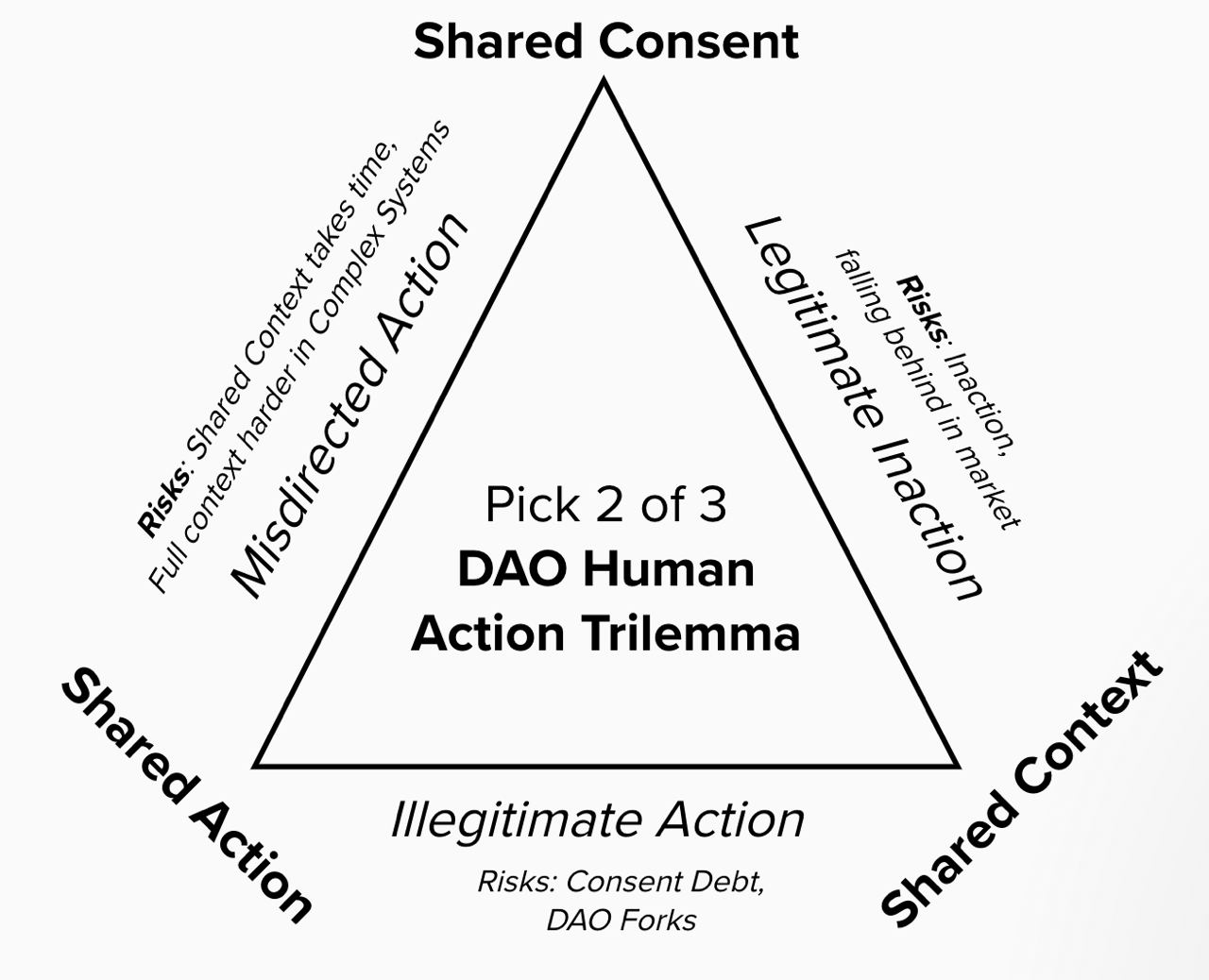
From Vitaliks post on DAOs and decentralization, we know that where Decentralization has value is:
- Decentralization for making better decisions in concave environments, where pluralism and even naive forms of compromise are on average likely to outperform the kinds of coherency and focus that come from centralization.
- Decentralization for censorship resistance: applications that need to continue functioning while resisting attacks from powerful external actors.
- Decentralization as credible fairness: applications where DAOs are taking on nation-state-like functions like basic infrastructure provision, and so traits like predictability, robustness and neutrality are valued above efficiency.
So my resulting take is: if areas of Gitcoin are in a concave environment OR need censorship resistance or credible fairness, then governance should be decentralized.
If not, then it is fine for it to remain delegated to some centralized actor (but subject to governance). But eventually it will trend towards decentralization.
As far as I can tell from poking around in CSDO/notion/youtube, the path ahead for Gitcoin is roughly:
- Scale product adoption.
- Figure out financial sustainability.
- Repeat until success.
- Ossify.
I suppose its worth asking which of the things in this path ahead would benefit from decentralized governance along the way.
The one that I feel that benefits the MOST from decentralization is “4. Ossify”.
Another way to visualize this is tradeoff space is:
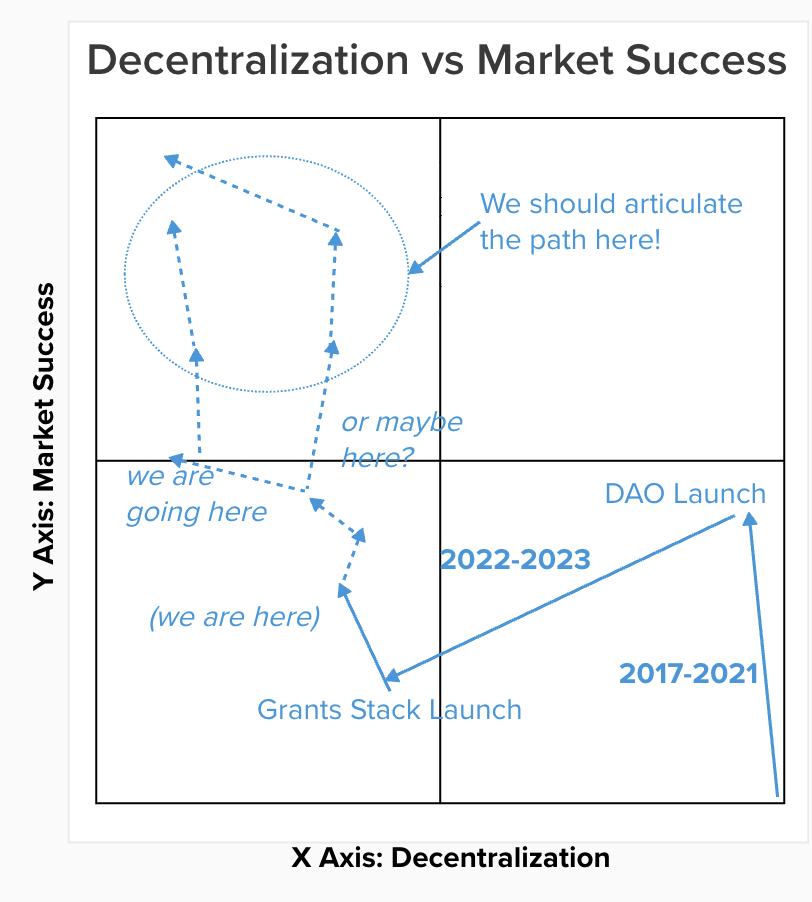
Do we disagree?
Idk if we are saying the same thing or not. But it feels like we maybe agree more than your OP gives credit for? Or maybe the disagreements are more nuanced?
How can I support you?
As a larger token holder, I’m actually very happy about planning a move in this direction eventually.
A move to quadratic voting was in the original vision for the DAO (which you can see here) (I wrote the below copy)
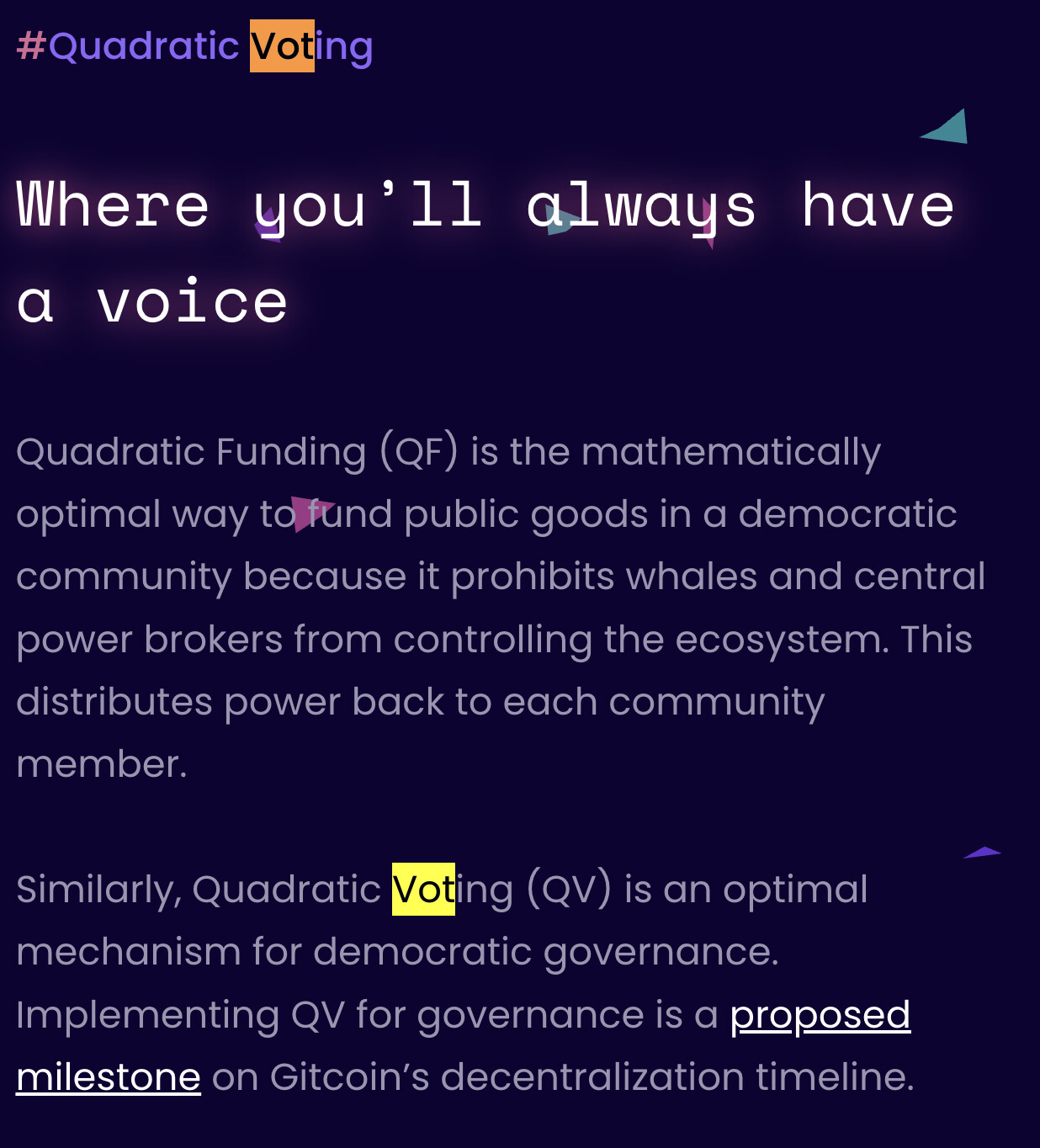
It has taken longer than I thought though, due to a lack of infrastructure to do it and also a lack of solid enough sybil resistance to get there. (which hopefully will change as Passport will enable enough sybil resistance to make it happen as it scales)
Disclaimer: This post is for informative purposes only and is not financial advice. This post reflects my personal views, not a decision or commitment by Gitcoin governance. Forward-looking items in it are targets, not commitments. The information in these posts is subject to change as we continue learning. This post may contain estimates, may contain errors, and is provided on a best-effort basis. DYOR, do not make any financial decisions based on these posts.