[PROPOSAL] Gitcoin d/acc 2026 Funding Initiative: Restructuring the Grants Program

Gitcoin d/acc 2026 Funding Initiative: Restructuring the Grants Program

Author: Mathilda DV.eth Status: Draft for Community Feedback Date: Q1 2026

Thank you to a number of community members who have given valuable feedback on the program, which directly influenced this renewed strategy.

TL;DR

This proposal recommends a structural overhaul of Gitcoin’s grants program. Not an iteration, but a deliberate rebirth. The core change: sunset Gitcoin Grants in its current form – large rounds run 1–2x per year – and replace it with a single, yearlong campaign focused on one domain, made up of targeted monthly campaigns at the subdomain level.

Why Now

With the ecosystem’s landscape changing rapidly, and our shift into the Gitcoin 3.0 era, we believe that it’s time to honour our history and how far we have come with our program to date. But it’s time to adapt and change. In order for us to make an impact and help define the focus in a more valuable manner, we have to be prepared for change.

Continuing as a generalist grants program is not a neutral choice. It can be a drift toward irrelevance.

What We’re Proposing

  1. Sunset Gitcoin Grants naming deliberately. This is not quiet abandonment. Q1 2026 includes a formal narrative separation announcement, a clear communication of the “why,” and an aggressive launch of the new program, with May as our target go live.

  2. 2026 domain focus as d/acc. We believe this is the current meta within the Ethereum ecosystem, and are focusing our efforts in 2026 to fund various verticals within this domain.
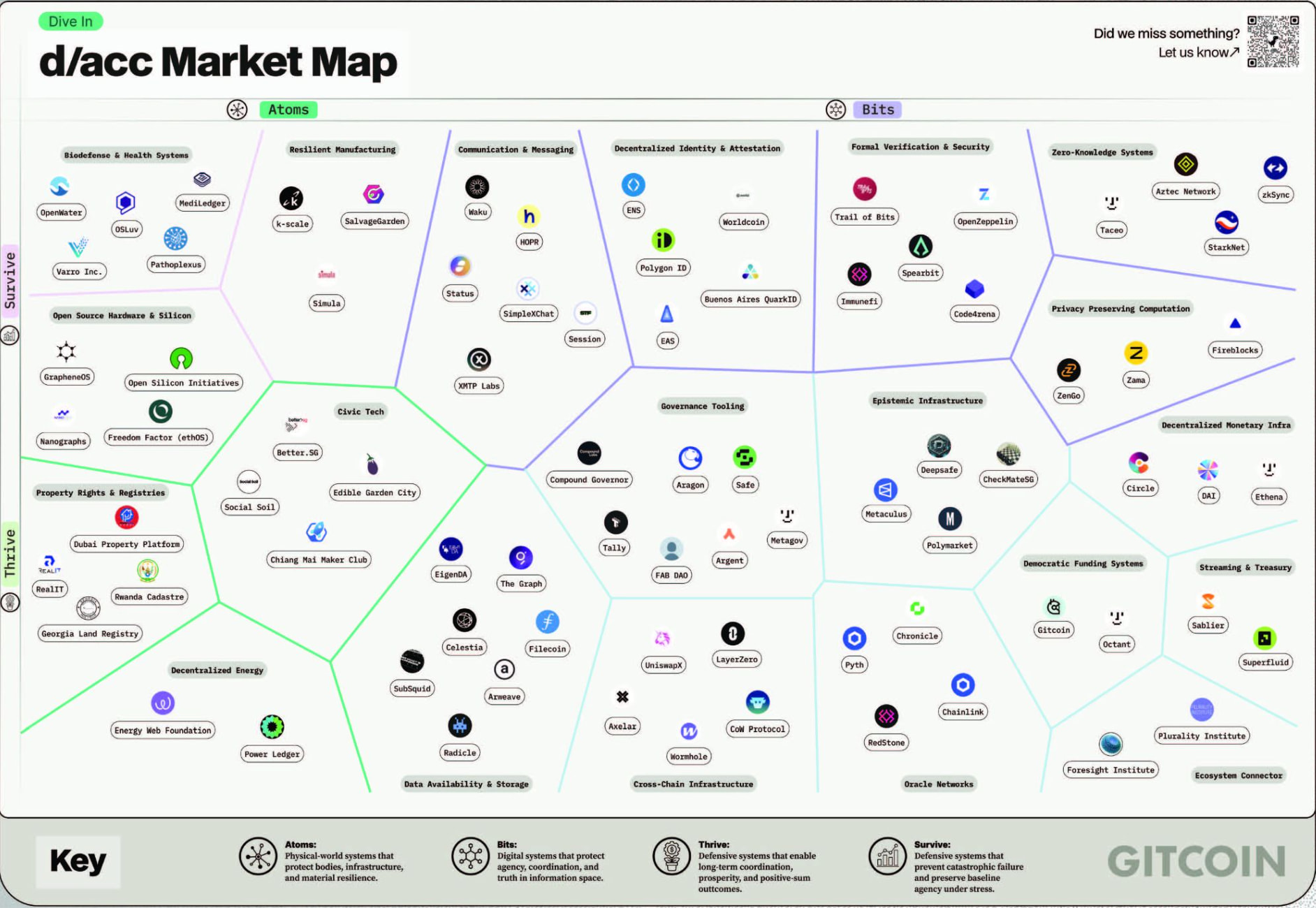
The above map is an evolution to our sensemaking process.

The map organizes the d/acc landscape into core subdomains, surfacing where builder activity is clustered and signaling where funding gaps may be most acute. It’s a living document, meant to be updated as the d/acc domain evolves, and serves as the sensemaking layer beneath the proposed 2026 Funding Initiative structure: each monthly campaign targets a subdomain identified here as both underfunded and high-opportunity – the intersection where Gitcoin’s capital can have the most leverage.

  1. Launch a flagship annual program with focused campaigns. Structure:
  • One umbrella program per year (e.g., D/ACC Funding Program 2026)
  • 3–5 campaigns (formerly “rounds”) within that domain, each targeting a specific subproblem
  • Curated entry, explicit evaluation criteria, milestone-based disbursement, required outcome reporting
  • Work with partners to co-design, co-fund and co-run each campaign
  • Include an accelerator-style structure alongside each campaign that can nurture, support and produce dealflow back into Gitcoin
  • Fund it with yield and coalitional funding, instead of drawing down the matching pool.
  • Get upside in the things that we fund, not just give $$$ away.

Capital & Governance

The new model cannot rely solely on community matching. The capital stack should include coalitional partners, with us aiming for at least a 1:1 ratio of funding per campaign.

Governance options under consideration: an internal selection committee, a domain expert council with Trust Graph structure, or a hybrid DAO vote + expert filter. Each has tradeoffs in legitimacy, speed, and signal value. Community input on this is welcome.

d/acc Campaign Strawmap

The below is an example of what the campaigns may look like through the remainder of this year.
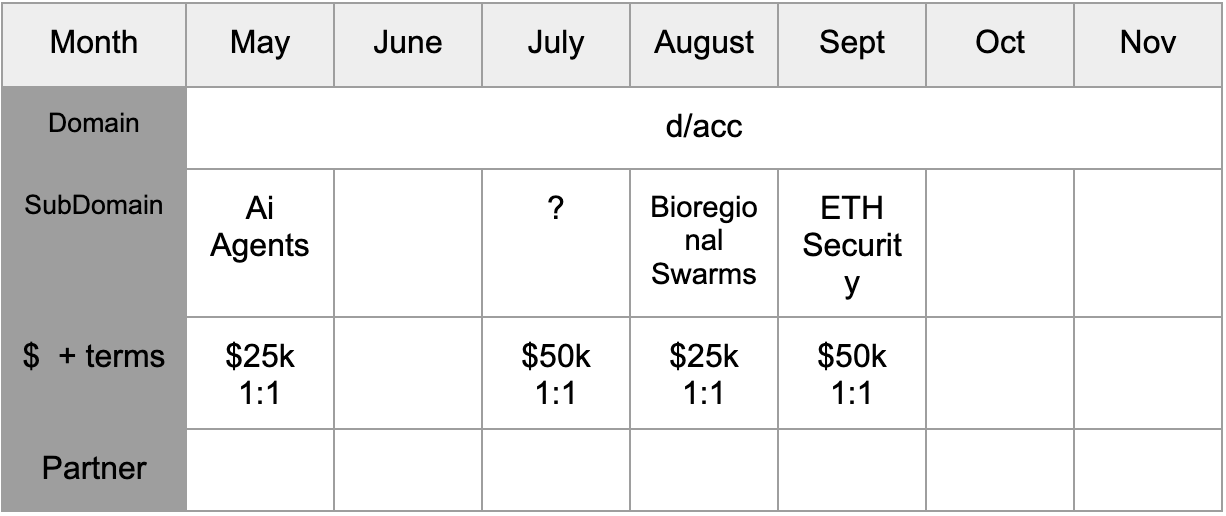
Alongside each campaign, we are planning activities that will balance and complement by the ways of accelerator-style programs. With each campaign being smaller than what we’ve run before, it will allow us to bookend each campaign more effectively and outline the strategies that will inform further impact evaluation and results.

Iterating on:

  • Intro of convertible notes to the funding mix
  • Define project types w/i sub domain that align w/ d/acc principals
  • 1-3 month to realize different campaign ideas

2026 OKRs (High Level)

  • Establish domain leadership: raise matching capital, secure institutional co-funders, attract high-quality builders
  • Increase capital efficiency: improve $ impact per $ deployed, reduce grant churn, track milestone completion
  • DPI - how much $$$ can we return to tokenholders/LPs?
  • Complete narrative repositioning: retire GG references across all channels by Q2, publish domain-specific thought leadership, secure strategic partnerships

What We’re Asking From the Community

  1. Feedback on the strategic direction: do you agree it’s time to restructure the program this way?
  2. Input on d/acc vertical selection: which categories within d/acc do you believe is most underfunded and highest-leverage for Gitcoin to own?

Final Thoughts

The alternative is deliberate reinvention: one tightly scoped domain, one clear capital thesis, one measurable outcome framework, multiple focused campaigns, and a governance model built for accountability.

Not evolution. Rebirth.

Feedback welcome!
14 Likes

seems directionally correct to me

4 Likes

I propose to amend this plan by allocating a “space” for AI Internet-Meritocracy as one of the funding methods:

gov[.]gitcoin[.]co/t/model-submissions-gg24-deep-funding/25151/2?u=vporton (I can’t include links in posts).

Hey @MathildaDV

I’m in favor of focusing on a single year-long campaign as previously recommended.

The d/acc Campaign Strawmap suggests a combined $150k will be spent on campaign matching. Is this a correct read? Those numbers feel relatively low compared to the over $1m USD spent on ops in 2026.

Could you also share more information regarding how these campaigns are curated and designed - is the current Strawmap just an example or based on legit, likely to happen programs?

What is the best way for previous and new partners / operators to align with the d/acc campaign?

Moving from a broad grants program to a focused d/acc funding engine can make Gitcoin more impactful and easier to understand.

My worry is that focusing only on d/acc could leave out many important projects, especially in places like Africa working on payments, inclusion, and identity that might not cleanly fit the theme. Using instruments like convertible notes can be hard for early-stage builders, especially in regions with weak legal and regulatory support.

2 Likes

The shift to a year-long domain focus sounds like it could create deeper impact and clearer narrative for the ecosystem. Curious how Gitcoin plans to ensure smaller or emerging builders still have easy entry points within each campaign.

My proposal (see above) is an almost perfect solution for this problem, among other problems.

The Case for Localism as a Core Sub-Domain of d/acc

1. d/acc’s central goal: improve the offense–defense balance

At the heart of d/acc is the claim that modern technology has massively improved offensive capability: AI can generate misinformation or automated attacks at scale, biotech can enable engineered pathogens, cyber tools can disrupt critical infrastructure, globalized supply chains create systemic fragility.

But defensive capability has not scaled at the same rate. Defense today is still largely organized around: centralized institutions, brittle global supply chains, fragile coordination systems, slow bureaucratic response.

d/acc argues we should accelerate technologies and institutions that make societies harder to break. This same logic applies to the material and economic systems that sustain human societies.


2. Localism increases systemic resilience

Localism is fundamentally about reducing systemic fragility by distributing capacity → local food production, distributed energy systems, regional manufacturing, local governance and coordination, place-based economic coordination etc..

These systems act as shock absorbers. When global systems break down, communities with local capacity retain the ability to function. Furthermore, distributed economic power reduces the ability of any single actor — state or corporate — to dominate society’s essential systems.

Localism reduces the number of catastrophic failure points in civilization’s infrastructure. From a d/acc perspective, this is defensive infrastructure — civilizational defense.


3. Introducing Localism Finance (LoFi): the economic defense layer

If Localism provides the institutional architecture of resilience, it also requires economic systems capable of supporting that architecture.

Most modern financial systems are placeless. Capital flows are optimized for global returns, and investment decisions are typically made far from the communities they affect. This structure often extracts value from local economies rather than reinforcing them.

To describe an alternative approach, we can define a new category → ‘Localism Finance (LoFi)’, referring to financial systems designed from place, governed by communities, and oriented toward the long-term flourishing of local economies, ecosystems, and cultures.

LoFi is not a single model or institution. It is a category of financial architectures that share a common orientation: enabling communities to govern, circulate, and retain economic resources within their own places.

Examples include:

  • Community Development Financial Institutions (CDFIs)
  • cooperative banks and credit unions
  • public banks
  • community land trusts
  • participatory budgeting systems
  • complementary and local currencies
  • mutual credit networks
  • bioregional financing facilities

Healthy ecosystems depend on the robust circulation of nutrients and energy. Healthy economies depend on the circulation of capital, goods, and knowledge within place. LoFi can help form the financial infrastructure of local resilience.

From a d/acc perspective, LoFi therefore represents economic defense infrastructure. It strengthens the ability of communities to maintain economic activity, circulate capital, and govern investment decisions even when national or global systems become unstable.


4. Localism is already operating at scale

Across domains, there is clear evidence that place-based economic and governance systems are already functioning at scale, and look set to continue growing.

  • Community finance: Community Development Financial Institutions (CDFIs) in the US alone manage $446 billion in assets across 1,378 institutions, while credit unions globally hold $3.8 trillion in assets and serve over 400 million members. These are large-scale, community-governed financial systems.
  • Cooperative economies: There are approximately 3 million cooperatives worldwide, generating $2.79 trillion in annual turnover and supporting 280 million jobs — around 12% of global employment. These represent distributed, member-owned economic systems operating at national and international scale.
  • Participatory governance: Participatory budgeting has scaled to 11,500+ processes across 7,500 cities, demonstrating that communities can directly govern significant pools of public capital. This is a real-world analogue to decentralized allocation mechanisms.
  • Land and housing: Community Land Trusts (CLTs) are expanding rapidly, with 300+ organizations in the US stewarding tens of thousands of permanently affordable homes, providing long-term protection against land speculation and displacement.
  • Complementary currencies and mutual credit: Thousands of local currencies operate globally. Switzerland’s WIR Bank, serving ~50,000 SMEs, acts as a counter-cyclical financial system, increasing activity during downturns and stabilizing local economies.
  • Local multiplier effects: Empirical studies consistently show that money spent in local businesses recirculates 3–7x more within local economies, strengthening economic resilience and reducing extractive leakage.

Taken together, these systems demonstrate that Localism and LoFi are not theoretical constructs. They are existing institutional patterns, already managing large flows of capital, coordinating communities, and stabilizing economies. And this looks set to continue growing.

  • The cost of coordination infrastructure is collapsing due to AI and Web3 tooling, making it viable for small communities to operate financial systems that previously required institutional scale.
  • Post-pandemic and geopolitical supply chain disruptions (COVID-19, Suez Canal blockage, Ukraine conflict, Red Sea disruptions) have made the fragility of globalised systems viscerally apparent to policymakers and publics alike.
  • The de-globalization trend is accelerating across both progressive and conservative political frameworks, creating unusual bipartisan alignment around local economic sovereignty.
  • Global municipal budgets total approximately $6 trillion annually — the largest pool of non-sovereign public capital in the world, increasingly subject to participatory governance experiments.

Localism is not a fringe movement waiting to be validated. It is a multi-trillion-dollar existing economy, yet still fragmented, under-coordinated, and under-tooled.

What is changing is the emergence of new coordination infrastructure. Web3 infrastructure enables transparent treasuries, programmable funding mechanisms, decentralized governance systems, and interoperable financial primitives that communities can use to manage shared economic systems without relying on centralized intermediaries. At the same time, advances in AI are dramatically reducing the cost of building and operating the software infrastructure required to support these models.

Together, these developments make it increasingly feasible for local systems to interoperate, replicate, and coordinate at scale while remaining locally governed.

5. Gitcoin’s unique positioning

Over the past two years, Gitcoin has already built the most significant body of practice, funding infrastructure, and community network in the Ethereum Localism space.

  • Proven place-based funding infrastructure: Localism Fund has mobilized $275K+ across 12 local programs, with a 2.36x matching leverage ratio through locally raised co-funding, indicating strong alignment between global coordination and local capital formation.
  • Emerging bioregional coordination network (Regen Coordination / BioFi): Through a series of interconnected rounds (BioFi Pathfinders, ReFi Mediterranean, Regen Rio, Regen Coordination Global), Gitcoin has helped prototype bioregional funding architectures — including the first bioregional-scale QF round — enabling locally governed yet globally connected funding flows across multiple regions.
  • Bioregional swarms and cosmo-local scaling: semi-autonomous, locally governed funding nodes connected through shared infrastructure — provides an early model for how Localism and LoFi systems could scale: replicable, interoperable, and coordinated across regions without centralization.

The synthesis

Resilient societies require defensive capacity in the material economy: food systems, energy systems, production networks, and financial infrastructure that cannot be easily captured, disrupted, or coerced. Localism strengthens these systems by distributing productive capacity and governance across communities. LoFi provides the financial layer that allows many forms of capital to circulate within place rather than being continuously extracted from it.

Advancements in Web3 and AI, alongside global geopolitical shifts and planetary challenges, create the conditions to accelerate Localism itself → local/acc: the rapid development and replication of place-based systems supported by globally shared knowledge, open protocols, and interoperable coordination tools.

In a world of increasing technological volatility, the ability for communities to coordinate, govern, and finance their own economic systems — while remaining connected to global knowledge and networks — may become one of the most important forms of civilizational defense.

2 Likes

Two structural concerns.

The curation model will determine whether this funds the next wave of builders or just the current wave again. Curated programs have a legibility bias – they select for teams that already know how to present themselves in the format evaluators expect. If the domain expert council is drawn only from people already embedded in the d/acc conversation, the pipeline will look exactly like the d/acc conversation already looks. The curation layer needs a mechanism to surface builders working on problems that fit the thesis but aren’t yet using the vocabulary.

On convertible notes – introducing investment instruments changes who can participate. Notes assume a legal entity, a cap table, and a path to a priced round. That structurally filters out experiment-first builders that Gitcoin’s QF model was built to reach. If you’re layering investment alongside grants, be explicit about which track a builder is entering. Mixing the two without clear separation creates mismatched expectations on both sides.

The d/acc sub-domain map is useful as sensemaking, but treat it as a discovery tool, not a selection menu. Some of the highest-leverage defensive acceleration work is happening in places and categories that don’t appear on maps like this yet.

3 Likes

GM!

  1. Friendly reminder:
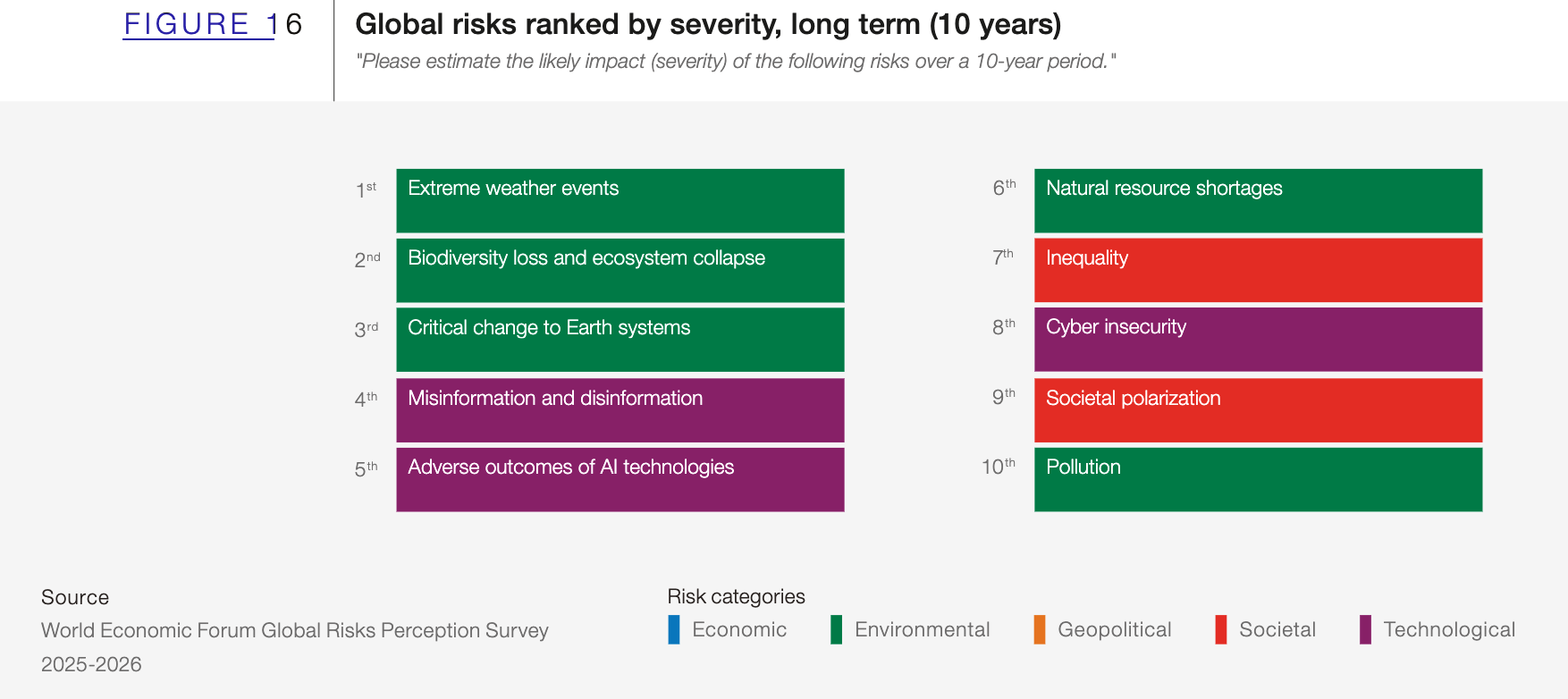
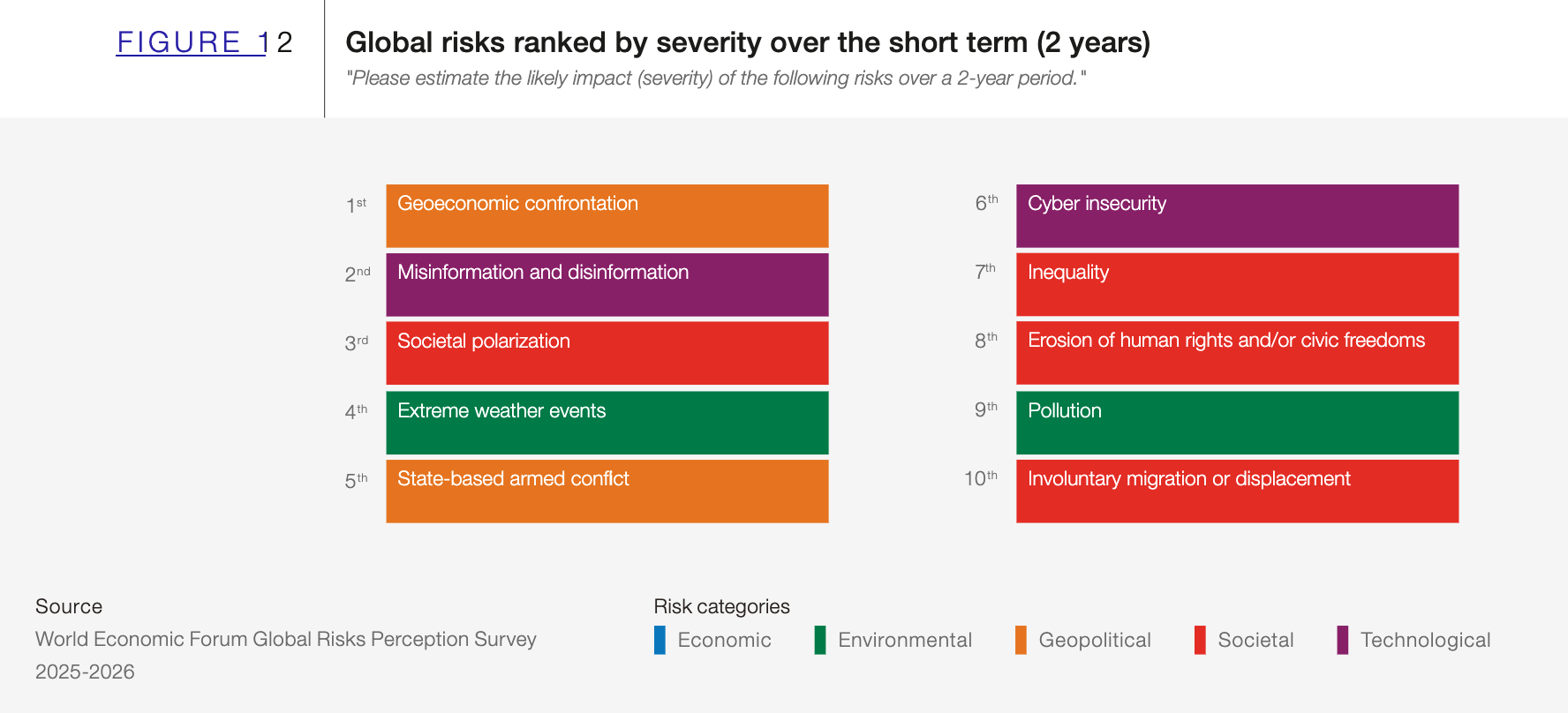
    d/acc (defensive, decentralized, democratic, differential accelerationism) organizes priorities across various axes. Gitcoin should align more closely with the WEF Global Risk Report 2026 by giving priority to underfunded short-term (Figure 12) and long-term (Figure 13) risks that need mitigation through an Ethereum localism ethos. This approach unlocks new ways to coordinate efforts, enable crosspollination, and identify sustainable, regenerative use cases for the long term.

The proposal looks awesome, but I believe that needs to be aligned more into the global risks mapped above, for proper scaling and implementation.

  1. On the other hand, I propose this vertical:

Frontier Open Science: d/acc Vertical for Gitcoin 2026

Frontier Open Science fuses DeSci execution with d/acc’s Framework Axes, creating Gitcoin’s premier vertical for tokenized research acceleration across Atoms/Bits x Survive/Thrive intersections.

Proposed Sub-verticals:

  1. Bio: security/diversity
  2. RWAs for Cybersecurity & Earth Systems
  3. Decentralized Education/Awareness
  4. Visualization/Metrics/Data
  5. AI + Blockchain Climate Mitigation
1 Like

The Strawmap is merely just a placeholder and an example of what it could look like. Confirmed numbers will be decided upon and ratified at a later stage. RE: your comment on the $1M DAO spend, that budget supports broader infrastructure, with the Gitcoin d/acc fund being a portion of that allocation.

RE: how new partners will align with campaigns. Thinking here is as soon as we release confirmed timelines we will create an intake of partners wanting to codesign with us. We are already in touch with a number in the space and will be releasing more information on this soon!

1 Like

The case for this direction is genuinely strong. We’ve known for a while that diffuse funding produces diffuse outcomes. Power law concentration across QF rounds and retro mechanisms alike tells us the top projects capture funding regardless of round design.

The shift to domain-led, metrics-enabled, expert-curated campaigns directly builds on what we learned in GG23’s retro round and the sensemaking work from GG24.

On the other hand, I see these as potential tensions that needs to be actively managed downstream of the restructuring:

  • “How much $$$ can we return to tokenholders/LPs?” is a genuine question but it’s a different question than “how much impact did we create per dollar deployed?” Both can coexist in a capital stack, but they don’t automatically align.
  • On legitimacy versus speed, a centralized committee with transparent criteria and published reasoning can have more practical legitimacy than a DAO vote with 3% participation and whale capture.

I support this proposal.

Apologies for not chiming in earlier, though I’ve been quite closely involved in the design of this d/acc funding initiative :slight_smile: