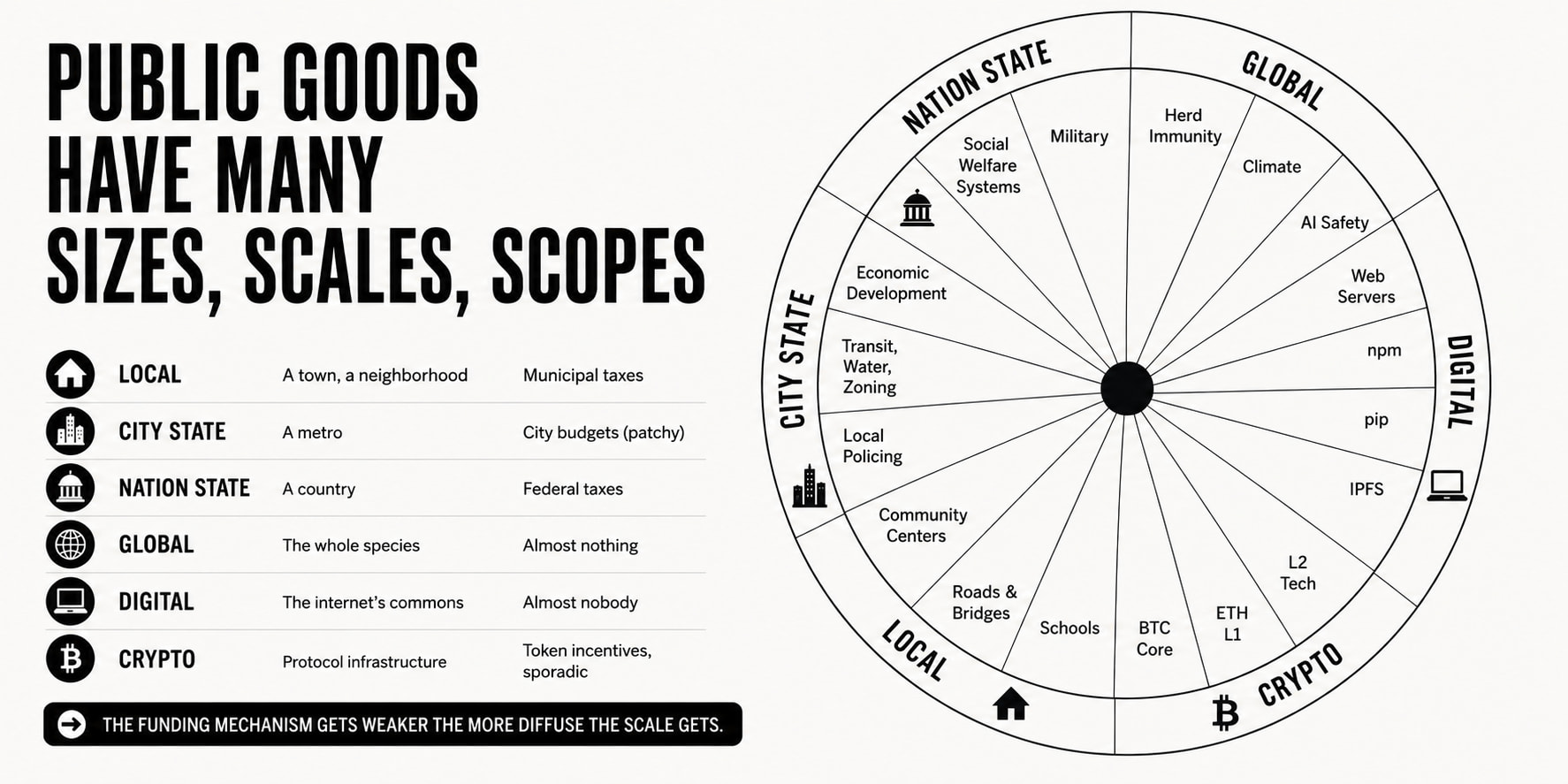
public goods show up at every scale of human coordination. we tend to fund them one scale at a time and rarely look at the whole picture at once. here it is in one frame.

the wheel slices public goods by scale: local, city state, nation state, global. plus two slices that aren’t geographic, digital and crypto.
| scale | what it is | example public goods | who funds it today |
|---|---|---|---|
| local | a town, a neighborhood | schools, roads & bridges, community centers | municipal taxes |
| city state | a metro | transit, water, zoning, local policing | city budgets (patchy) |
| nation state | a country | social welfare systems, military | federal taxes |
| global | the whole species | climate, herd immunity, pandemic prep | almost nothing |
| digital | the internet’s commons | web servers, npm, pip, IPFS, AI safety | almost nobody |
| crypto | protocol infrastructure | BTC core, ETH L1, L2 tech | token incentives, sporadic |
the pattern
read the right column top to bottom. the funding mechanism gets weaker the more diffuse the scale gets.
- local goods have a tax base. a town funds its roads.
- national goods have a tax base. a country funds its military, whether or not you like how.
- global goods have almost no funding apparatus. there’s no world government, so climate and pandemic prep live on whatever nation-states feel like donating.
- digital and protocol goods have essentially nobody. npm, pip, the web servers half the economy runs on, held up by a handful of unpaid maintainers.
so the underfunding is worst at the outer edges, and the instinct is to aim funding there.
where the work actually is
the most underfunded scale and the highest-impact scale for us are two different scales. the place to push is local.
the force eroding public goods at every scale is the same one: winner-take-all network monopolies. the internet let a few platforms consolidate and extract from everything underneath them, and ai is accelerating it, moving people from small-business owner to employee to laid off. you can’t out-fund that at the global scale, there’s no mechanism up there to pull on. the local scale still has a tax base, still has civic institutions, and is the one place the fight against monopoly is winnable. 80% of the country lives in cities.
one thing i’m considering is what it’d look like to do quadratic funding (and other coordination infra) at the local scale. a matching pool per city, repointed from ethereum open-source software to city resilience. you give a dollar to a local business or a local project, and a broadly-supported one pulls real matching out of the pool. the same mechanism that funded ethereum’s commons, aimed at main street.
the ask
a few questions for governance:
- how do we represent the overlapping nature of public goods? eg if a network monopoly is extracting from the local and hollowing its public goods, how do we show that reflexive loop?
- is local the right aim, or should we chase the global and digital edges where the underfunding is objectively worse?
- does QF-for-cities hold as a mechanism, or does the local scale need something quadratic funding can’t give it?
- for a pilot: which city, and what matching-pool size crosses the activity threshold? (working guess: $25k to $100k per city.)