We should be facilitating stakeholders to conveniently form an overall impression of a projects progress along its pathway. It is currently very difficult to navigate between different rounds grant applications.
Having links to projects previous applications would greatly help identify discrepancies also. If a project has participated in GC18 their application for that round and the previous rounds they have participated in throughout their tenure should be linked in their GC19 application and subsequently their grant page. Taking for example one of the largest recipients of funding in the GC18 Climate Round and their prior rounds submission you can see that total prior funding was never updated - both are $150,000.
Importantly we should highlight projects referencing each other and help determine if they should be presented as a bundle instead of having their own individual grants.
Highly recommend listening to the GreenPill Ep 109 Podcast with Joel Miller author of the Beyond Collusion Resistance: Leveraging Social Information for Plural Funding and Voting Paper.
It seems like the current application of clustering discounts donations from those with the best overview of a project - local donors with whom the project has engaged with. It’s a great shame to discount the fidelity of local donors in the projects own network who have a better overview of the projects determination to generate impact. In order to address concerns around localised collusion we should make the cost of collusion more expensive rather than squelching it entirely.
Donations from the same cluster should have a higher minimum before they are considered for matching funds. Even then they could only be matched at a lower ratio. Donors that are cluster mapped together would have to stake more for the same result. As a reflection of their belief in a project they are familiar with they should be happy to donate more.
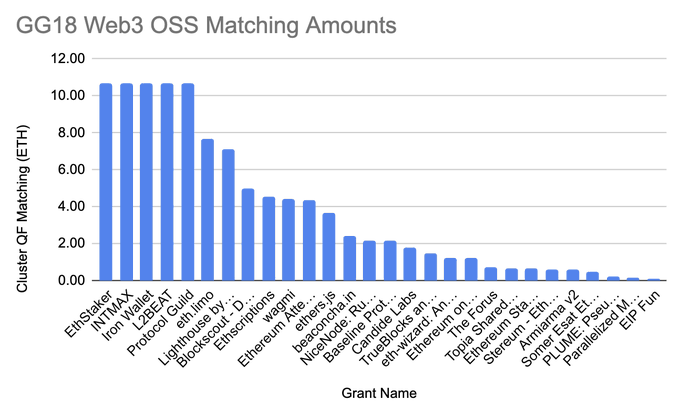
i wonder if this is a feature or a bug.
— Kev.Ξth (🍄,🟢) (@owocki) September 25, 2023
if bug: it would be possible i future versions to tune the algorithm to distribute matching pools more widely. either by lowering the cap per grant, or by tuning the QF variables such that its got less runaway powerlaw distribution. pic.twitter.com/VpiSJcn6wZ
‘The moral reality’ of what is happening here with the steep Pareto distribution of funds in the climate round and others is exactly what we should be looking out for. To lean into the analogy about the park - we should not be funding just one park to the gills while others are left without adequate water. This is a bug.
Combining the Better Impact Funding approach outlined here with tooling that guards against collusion amongst clusters of projects rather than individual donors should result in more equitable distribution of funds.