Add TrustaLabs returning sybil scores on wallets. https://www.trustalabs.ai/trustscan
They were the top prize winner in the first Open Data Community hackathon and subsequently got funding and returned to sponsor the current ODC hackathon!
To me, a protocol DAO isn’t just a DAO with a protocol. We have multiple protocols and each has to independently find ways to create positive outcomes via collaboration with the others. At this time, it is easy because our essential intents have guided funding. How about when more funding from the ecosystem comes from outside the dao?
I think we clearly match the definition David Erlichman puts forward in Impact Networks. I’d love to see a mechanism design built into each of the independent protocols which governs, bootstraps network effect, and funds maintenance balancing the labor and capital inputs via the market.
This entire section is great. Well written and well thought out.
I think we should be careful here. I agree that we should have these fees from the start, but the question is which side (or both) do you take them from?
Donors
I’d put these into the protocol. Donors have no means for forking and a small percentage here wouldn’t hurt a Program manager. The Unicef and Fantom rounds both saw individual donors almost double the matching pool provided. The value prop that not only do you save vs the admin overhead of traditional options, but you also increase funds given to your community is huge. We should take a percentage of this.
Additionally, perhaps there is an extra percentage that is optional in the UI. This could be for donors to decide individually or for program managers to make mandatory.
Matching Funders / Program Managers
This group is more likely to have incentive and capability to fork. Making fees to them as either optional for rewards like discoverability in the UI during the quarterly “festival”, inclusion in meta-QF (jet engine QF), is a fair trade.
I’m very concerned that once we begin taking revenue, we will set our goals in ways that slowly eliminate our efforts for the public goods parts of our ecosystem. The best way to stop this from potentially being a problem is to design public, transparent, and ratified processes for Gitcoin to hold investment in workstreams which find a way to produce revenue. This would clearly set the line that GitcoinDAO treasury is ONLY funding public goods in our ecosystem.
However, if the experts in a workstream are the only viable option for providing services which are needed AND they are able to demonstrate the ability to collect revenue and forecast a profitable future, then Gitcoin should invest in that business with favorable conditions.
We do have a session on updating the essential intents next week. I’d like to get to those results before entertaining a re-org of any type.
I’d think of this as the services spin out from PGF. Whereas the Grants Program Workstream would be the governance and operations of the Gitcoin Program, this workstream would start with free support services for non-gitcoin programs and add on sales tiers. We would need to subsidize this workstream to start, but hopefully it is self-suffient soon. (We are working on revenue modeling at FDD and will see potential soon.)
I love this. It could likely be an allocator to independent community efforts with a salary lead for each group. DevRel, Open Data, Regen Maxis. This group is all about engagement!
There is a huge opportunity for services to generate out of this workstream as well. They should work closely with the growth workstream. In discussions with people in decision maker roles for setting up grants programs for large ecosystems, I have found that they DO NOT separate the idea of a grants program from governance. For many, this IS the problem.
I don’t see FDD ever spinning out, rather “birthing” a subDAO that then spins out. There is likely room for some expertise from FDD to participate directly with the Passport WS. However, there are multiple issues where FDD would still need to coordinate across workstreams.
- How does Identity play into grant scoring?
- How does community scoring play into grant scoring?
- Compound algorithms - Donors in the round which have majority donations to grants flagged as preferred by burner wallets?
This is a poorly constructed visual made by yours truly.
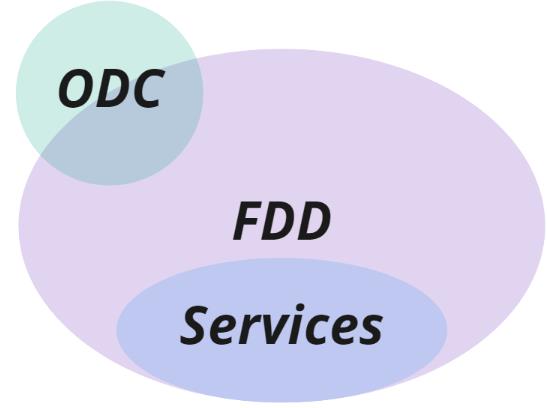
The idea is that service revenue might go into a molochDAO with all of our contributors rather than the FDD Primary Multisig. Then, all revenue generated before spinning out could be considered a SAFE/SAFT type investment. This paragraph is conjecture, but worth considering.
Then we must think, what needs do we have and what is left?
If we don’t continue to build the open source tools to defend rounds, then companies with closed source solutions will have the advantage until someone is willing to fund the building of open source software to do the trick.
ODC builds open source projects.
- Exploratory Data Analysis
- Analysis Legos
- Data Extraction Infrastructure
FDD maintains data infra & data products.
- Open Source Scoring Applications
- Ad Hoc Round Analysis
- BI Tool Maintenance
- Prioritization and Specifications for Fraud Defense Analysis & Builds from ODC/DevRel
FDD Service Spin Out
- Freemium Model Product
- Consulting Services
I could see a goal being to have a self-sustaining business and bring down the FDD budget to $0 by 2024. Another option would be to include the FDD work in the Growth WS.
Something like this:
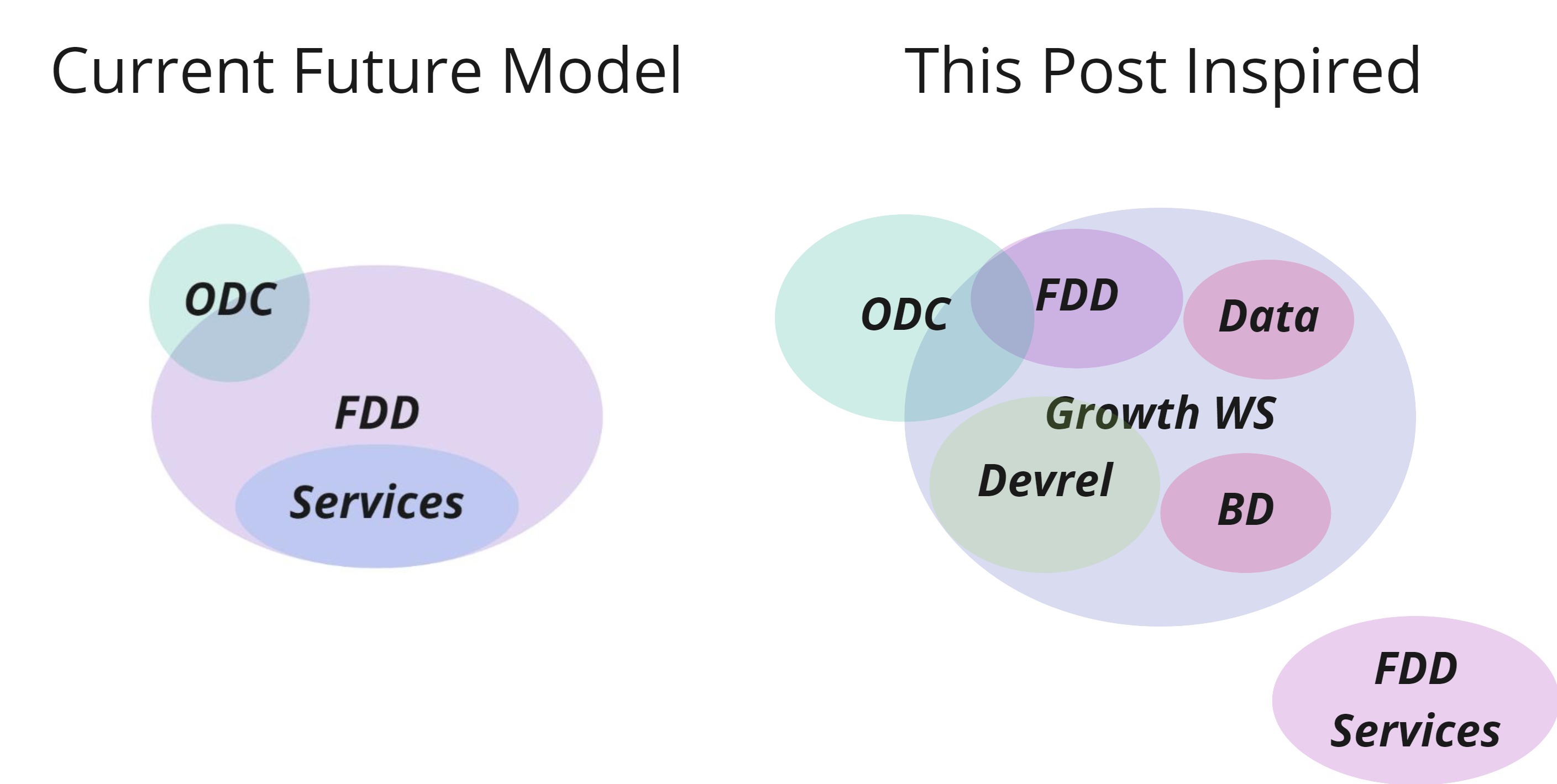
There is a thought I’ve had that we don’t really have any labor protections and the larger workstreams do in a way facilitate some level of member protection.
Either way, I’d really like to see the new essential intents before restructuring the org!
Additionally, I’d like to see Passport, Project Protocol, and the Program Protocol each be their own workstream.
My last point on this topic is that we plan for these spin outs and org changes together. Unless a workstream is not performing, they should be given reasonable advance notice of changes in structure and pay along with a clear timeline of changes/requirements.
The one thing I will definitely advocate for in a budget process redesign is tighter cycles. It’s like cleaning your room. If you wait too long to do it, then it will be a pain. Plus, its a known evolutionary advantage to shorten information gathering (nervous system) & resource distribution (circulatory system).
I’ll bet that one year from today it is obvious that we are an impact DAO with 3 protocol subDAOs, multiple service subDAOs, and a few workstreams 