about $15.2m of gitcoin’s treasury and matching pool is sitting in plain usdc and eth earning nothing. at conservative rates that’s roughly $500k a year we’re leaving on the table. i’d like us to put it to work.
what’s idle
wallet
idle
~usd
matching pool safe 0x25A84CC1014062463a829Fbc2B0848798BF5E378
gtc (about 15m tokens across the timelock, the csdo multisig and the matching pool) isn’t counted here.
what it’s costing
idle
assumed rate
per year
stables
$8.2m
~4%
~$330k
eth
$6.9m
~3% (staking)
~$210k
total
~$540k
the rates are my rough assumptions.
the proposal
in february we ended avantgarde’s mandate and said the pool would be managed “through dao-controlled, non-intermediated approaches.” this is the second half:
keep runway liquid: 12 months of opex stays in plain usdc
the rest of the stables go into a short list of plain, battle-tested, onchain yield sources (for example sky savings or aave)
eth gets staked through liquid staking
no external manager. the dao’s own safes hold every position, and anyone can verify them onchain
yield funds matching, per the february proposal
a regular report on this forum: positions, yield earned, any losses
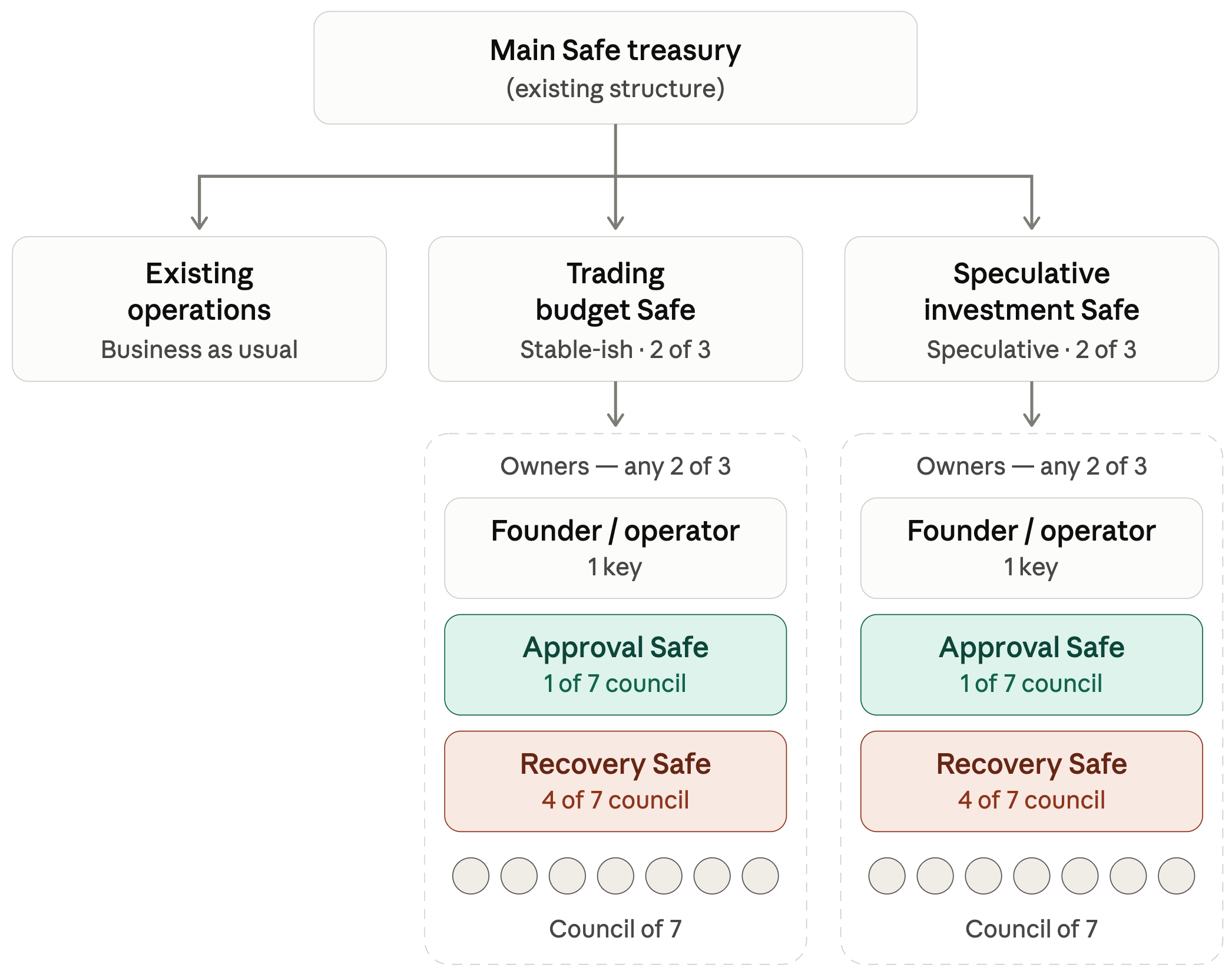
a trading mandate
markets move faster than a governance vote. i’d also like the dao to give me and the gitcoin foundation a standing mandate to trade in and out of liquid coins on the dao’s behalf (for example rotating between stables and eth, or out of the old donated tokens sitting in the matching pool), so we can act inside a week instead of a month.
the guardrails i’d propose:
liquid coins only: stables, eth and its liquid staking tokens, and the large donated tokens with deep markets. no leverage, no derivatives, nothing illiquid
foundation safes, foundation signers. trades execute from multisigs where foundation signers have to approve, so i can’t trade alone
a cap per quarter (say 35% of the liquid treasury) set by the dao and changeable only by the dao
the dao can revoke it with a simple vote at any time
the risks
smart contract risk is real, and that’s why nothing exotic goes in. staked eth can depeg briefly in a panic, which is why runway stays in plain usdc. and we pay a few hundred dollars in gas plus signer time.
my view is that $500k a year beats those costs by a wide margin.
the ask
should the dao deploy idle treasury assets for yield?
is 12 months of liquid runway the right buffer?
which yield sources would you trust, and which would you veto?
should me and the foundation hold a trading mandate for liquid coins, and are the guardrails above tight enough?
if this lands, i’ll come back with a formal proposal naming the exact protocols and allocations.
owocki
Disclaimer: This post is for informative purposes only and is not financial advice. This post reflects my personal views, not a decision or commitment by Gitcoin governance. Forward-looking items in it are targets, not commitments. The information in these posts is subject to change as we continue learning. This post may contain estimates, may contain errors, and is provided on a best-effort basis. DYOR, do not make any financial decisions based on these posts.
spark for sure. potentially aave but trust them less tbh as so many partners who are acting less safely than they are (see that recent hack which caused all eth to get blocked for a month)
You are uniquely positioned to execute some trades.
Me asking AI how to phrase it in a compliant way
DYOR.
I put human into prompt.
Then Opus 5.5 and GPT 6.1 back and forth a few rounds to mututally fact-check each other.
What you see below is the processed result, some “group think” may occur so when feeding to another AI be explicit about adversarial fact checking.
This legal advice is not legal advice.
A) Information edge
Legitimate: network edge, mosaic theory (public information plus non-material scraps), deal flow, proprietary research.
Crosses the line: trading on precise, non-public information likely to move the price significantly. Under the European Union’s Markets in Crypto-Assets Regulation, where its market abuse rules apply, it’s enough that you know or ought to know it’s inside information. No non-disclosure agreement or breach of confidence is needed. A mosaic doesn’t clean up inside information mixed into it.
Reflexivity (George Soros) describes feedback between beliefs, market prices and fundamentals. It isn’t a legal exemption. Buying before publishing genuine research can be lawful, but:
Disclose your position when you post, not after.
Don’t mislead. False or misleading statements can be fraud or manipulation. Musk settled fraud charges over “funding secured” without admitting or denying them.
Disclose paid promotion, including the source and amount. That was Kardashian’s 2022 settlement.
Don’t put yourself or anyone else ahead of the fund, and don’t share its pending orders.
Jurisdiction: different rules apply in the United States, the European Union, the United Kingdom and elsewhere. They depend on where you, your investors and the markets you trade are, not only where the entity is registered.
Good practice: document where your information comes from, control personal dealing, and check public statements against your trading plans.
Yes — and the yield destination matters as much as the yield source.
The natural pairing is yield → matching pool. Principal stays conservative (Spark/Aave at sane rates), and the ~$500k/yr becomes match that exists before it’s promised — the invariant the bread-cooperative thread is converging on post-Artizen. Octant already proves this shape works (locked GLM → WETH rewards → rounds); Gitcoin running it at treasury scale is the bigger version of the same proof.
Two additions from our build worth stealing:
Continuous match, not batch match. Superfluid-style streams let yield accrue to the matching pool continuously, so rounds can draw on “yield to date” rather than waiting for harvest cycles. We’ve got these builders live on Celo.
Ledger-visible treasury. Whatever the custody structure, every treasury event should land on a publicly-verifiable append-only ledger — hash-chained, externally anchored. “The yield went where it said it would” should be recomputable by anyone, not attested in a report. Ours is at /ledger/verify; the pattern is trivially portable.
And a sharpening from experience: yield alone doesn’t scale matching fast enough (that was the original critique that pushed us toward endowment design). At ~4-6% on $15M you’re at ~$500-900k/yr — meaningful, but the pool also needs growth mechanics (sponsor inflows, secondary-market fee capture, round fees routed back) or the endowment stays a subsidy rather than becoming a flywheel.
I like the simple idea of converting ETH into a yield bearing version of it.
we have some experience with sUSDS (Sky’s yield bearing stablecoin) and can recommend. Its a good way to earn yield passively, perfect for large treasuries that dont want active management
This is a strong proposal, and I agree with the core premise: $500k/year left on the table is a real cost, and the DAO should put idle stables to work.
I’d like to offer BizMarket as a candidate for the short list of yield sources; specifically for a portion of the stablecoin treasury.
What BizMarket is: An RWA yield aggregator that tokenizes emerging market sovereign Treasury Bills as on-chain assets. We pay fixed yield in USDC, backed by government-issued instruments, held through a registered SPV. We’re live with 70+ tokenized businesses, 1,500+ users across 55+ countries, and a licensed lending entity.
Why it fits the brief:
Yield: 13–15% in USDC, paid annually. Materially above the ~4% assumed for stablecoins.
Backing: Emerging market sovereign Treasury Bills, held through an SPV. Not a lending pool, not a farm, not a vault that depends on a smart contract strategy. The yield comes from sovereign debt service, not from protocol incentives, essentially touching the real economy.
Liquidity: Quarterly payouts with defined maturity dates, so the DAO can plan around the positions.
Verifiability: Positions are tracked onchain and treasury holdings are reported. The DAO’s safes would hold the positions directly, which matches your principle of no external manager.
FX risk: The obvious question for emerging market yield. We manage it through an FX-lock partnership with CrebitPay, which locks the USD/local currency rate for the term of the instrument. The DAO would receive a fixed USD yield without taking currency risk.
What I’d propose for the DAO specifically:
Start with a $200K–$500K allocation from the treasury safe, not the matching pool.
Keep the rest of the stablecoin treasury in plain USDC or Aave/Sky as proposed.
Use the BizMarket allocation as the higher-yield RWA sleeve of the short list — the one that lifts the blended return above 4%.
Quarterly reporting to the forum, same as your proposal asks for.
On the risks you named: smart contract risk is real. BizBond is backed by sovereign instruments held by an SPV, not by a DeFi strategy. The DAO’s exposure is to emerging market sovereign credit and to the FX lock, both of which are disclosed and reportable.
API access: Institutional allocators can deploy capital directly through the BizBond API — BitSave - Your Crypto Savings Protocol — which lets the DAO’s own signers mint positions, track allocations programmatically, and manage withdrawals from the treasury safes. No external manager required.
I’d be happy to present BizMarket in the formal proposal stage if the DAO is open to adding an RWA yield source to the short list. I can share our portfolio rationale and PlayBook, the FX-lock structure, and the API documentation in detail.

 into prompt.