Another very much underexplored public goods funding mechanism that I’d like to see more experiments with is a concept called Partial Common Ownership. It’s also known under the acronyms COST (Common Ownership Self-Assessed Tax) and SALSA (Self-Assessed Licenses Sold at Auction).
Consider a system where property owners themselves specify the value of their property and pay a tax rate towards public goods of, say, 2% of that value per year. But here is the twist: whatever value they specify for their property, they have to be willing to sell it to anyone at that price.
The theory promises that this gives us more productive and just markets than capitalism and communism. Follow this excerpt from @GlenWeyl and Eric Posner’s 2018 book “Radical Markets” to read more about the mechanism’s political-economic philosophy and mechanics: https://assets.press.princeton.edu/chapters/s11222.pdf.
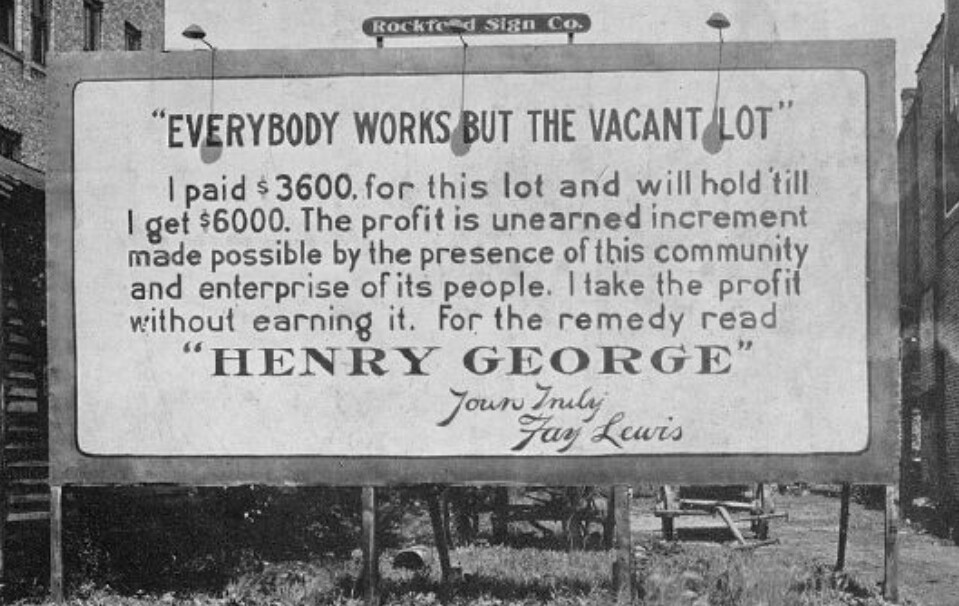
Henry George kickstarted the movement for property value taxes back in the 19th century..
Here are some neat implications of self-assessed property taxes in democratic, self-organizing ecosystems I want to highlight:
- If the value of a private property goes up, the income of public treasuries goes up. Rightly so, because the value of “private” goods often goes up due to community effort. For example, Moonshot Bots sell well because the community likes them. The Empire State Building is valuable because Manhattan’s unique, vital, and diverse community makes it a sought-after and famous real estate. Billboards like in the above figure are pricey because communities look at them! Just as the eyeballs of the people in the Gitcoin community might look at this website right here and now or gitcoin.co/grants, and many more websites. (More on the subject of websites in a bit).
- Assuming informed/rational behavior among the agents, the allocative efficiency of any property is nearly maximized while maintaining investment efficiency.
- Less room for price discrimination in property markets. See an illustrative example of the problem here, as it looks like single women are losing out due to price discrimination in property markets under capitalism.
- Unjust deprivation of property (as in genocides and slavery) does not come with permanent property rights for the new proprietors.
What are some exciting experimentation opportunities around this idea?
- Content-control rights on websites.
- Imagine “featured grants” on Gitcoin webpages. Community members would exchange the rights to publicly display their favorite grants on these pages. The resulting value taxes could go to the Gitcoin grants treasury. Besides the continuous revenue stream for the Gitcoin Grants treasury, this would also solve the inevitable social problems around grants sortition on gitcoin.co/grants, @annika, @connor, and @ceresstation.
- Imagine a similar arrangement for featured token pairs on Uniswap. Again, the related tax could go to the Uniswap grants treasury. (It looks like a social tool like this would be a natural match for DAOs.)
- Imagine self-assessed control rights of ads/content would become the default on the web.
- ENS names. Web domains.
- Art/music NFTs. (Although personally, I’d prefer more open-source art/music production funded quadratically.) For instance, Moonshot Bots generated a one-time payment for the grants treasury. In comparison, with self-assessed licenses, every Moonshot Bot NFT might have continuously generated Gitcoin Grants treasury revenue until today and beyond.
- Almost any intellectual property (e.g., voting rights, software)
- Block proposer rights after the Ethereum merge. The mechanism could help deconcentrate power on the consensus layer of proof of stake blockchains more generally.
- To name a few of the countless physical property examples: screen control rights at conferences, billboards, land, machines, e-scooters, trains, apartments, offices.
The sky’s the limit. And I’d love to help drive a Moonshot around this mechanism. For example, call it ads.party considering the website content control rights the lowest hanging fruit. There’d be generally two different approaches to kick this off, either double down on a particular case, say Gitcoin Grants ads. Or on the other hand, on building a software development kit for website administrators like Gitcoin, Uniswap, and The Economist to govern ad/content control rights on their pages.
Check out some existing repositories and prototypes around the partial common ownership mechanism here:
- GeoWeb imagines the mechanism in augmented realities: Geo Web · GitHub
- Nonomos is a prototype of it for media control rights on websites: GitHub - anoanoano/NonomosHL: A Harberger License administration system with a simple interface and "video grid" demonstation on the front-end.
- Wildcards applies it to art NFTs to fund wildlife conservation: wildcards.world · GitHub
- “This Artwork Is Always On Sale”: GitHub - simondlr/thisartworkisalwaysonsale: A digital art project on Ethereum that uses harberger tax to have an always-on auction. Tax is patronage to artist.
- Calendar.org is a live experiment to assign global names to days on the Gregorian calendar: Address: 0xb283c835...21E263C78 | Etherscan
The blockchain era opens a vast design space for programmable markets. However, let’s not trick ourselves into the exact design mistakes like permanent ownership that inevitably lead to disproportionate power concentrations and conflicts. Instead, builders, in the name of public goods and democracy: Let’s dare to prototype more radical markets that benefit ecosystems holistically.