At the risk of being reductionist but in the interest of expediency, I am attempting what it might look like to undertake some experiments in the next 100 days to nudge our journey rightwards on the dotted path up. This is complimentary to any long-term efforts still needed to bring diversity in delegation and adopting QV.
Premise - Multiple means of decentralization
Governance comes from the Greek verb kubernaein: to steer. While it is absolutely essential to curate and ensure the hands-on-the-wheel are representative of the needs of the community, it is also true that a great number of decisions that directly impact the work product happen across the multiple decks stacked underneath.
In expanding the conversation beyond the centralization/decentralization dichotomy, the paper Decentralisation: a multidisciplinary perspective argues:
Just as the robustness of a distributed system comes from the multiplication of the means through which something takes place, so does the robustness of our complex social, economic organisation depend on having multiple different systems to achieve similar goals.
Beyond the scope of binary decisions on the voting proposals, are there near-term opportunities to open up concave choices within workstreams for sensemaking with the community? Can we cultivate bottoms-up ways of working where community members with appropriate context and skill find low-friction pathways for micro-contributions? Can a fly-wheel effect of this over time help us create future helmspeople and thought leaders for the DAO?
Culture as the ultimate “most important thing”
A possible pathway might look like this:
- Interested contributors in the community are exposed to the context of work
- More hands with skin-in-the-game but outside the core team start to shape outcomes
- Better appreciation in the community for “mountains that need to move” for delivering results
- Initial experiments pave the way for organic channels for ongoing dialogue with the community
Ultimately, actions evolve into habits where eligible problem spaces become open for community input at the relevant granularity of detail. This shapes the culture once it becomes second nature for the DAO, as Edgar Schein puts it in the book “Organization Culture and Leadership” in these terms:
Culture is a way of working together toward common goals that have been followed so frequently and so successfully that people don’t even think about trying to do things another way. If a culture has formed, people will autonomously do what they need to do to be successful.
The question to ask and its cost
How might we influence the work products in the DAO that helps us realize the most important things with context-rich contributions from the community with modes of engagement that are sensitive to the commitments needed from the core team of the DAO?
I have a few ideas at the operations level to enable this that I would cease from expanding here in the interest of validating if this even is the right question in the pursuit of decentralization (e.g. why not host a “governathon” with bounded scope to solicit inputs for this very exact problem). There are costs involved in enabling this, the most critical being focus and efficiency of the core team. I have watched this team from the sidelines launch 3 rounds in 8 months, where each iteration included a tremendous amount of feature lift to pivot from product to protocol while also helping the stakeholders and community move along the transition. My familiarity with web3 is limited, but I have spent two decades in different roles in systems development and I have not seen any team pull a transition of this scale and with this quality of outcome in such a short time. There is no doubt this feat has allowed the community to exit a local maxima and leapfrog to an alternative future with a greater plurality of possible outcomes.
So what’s next?
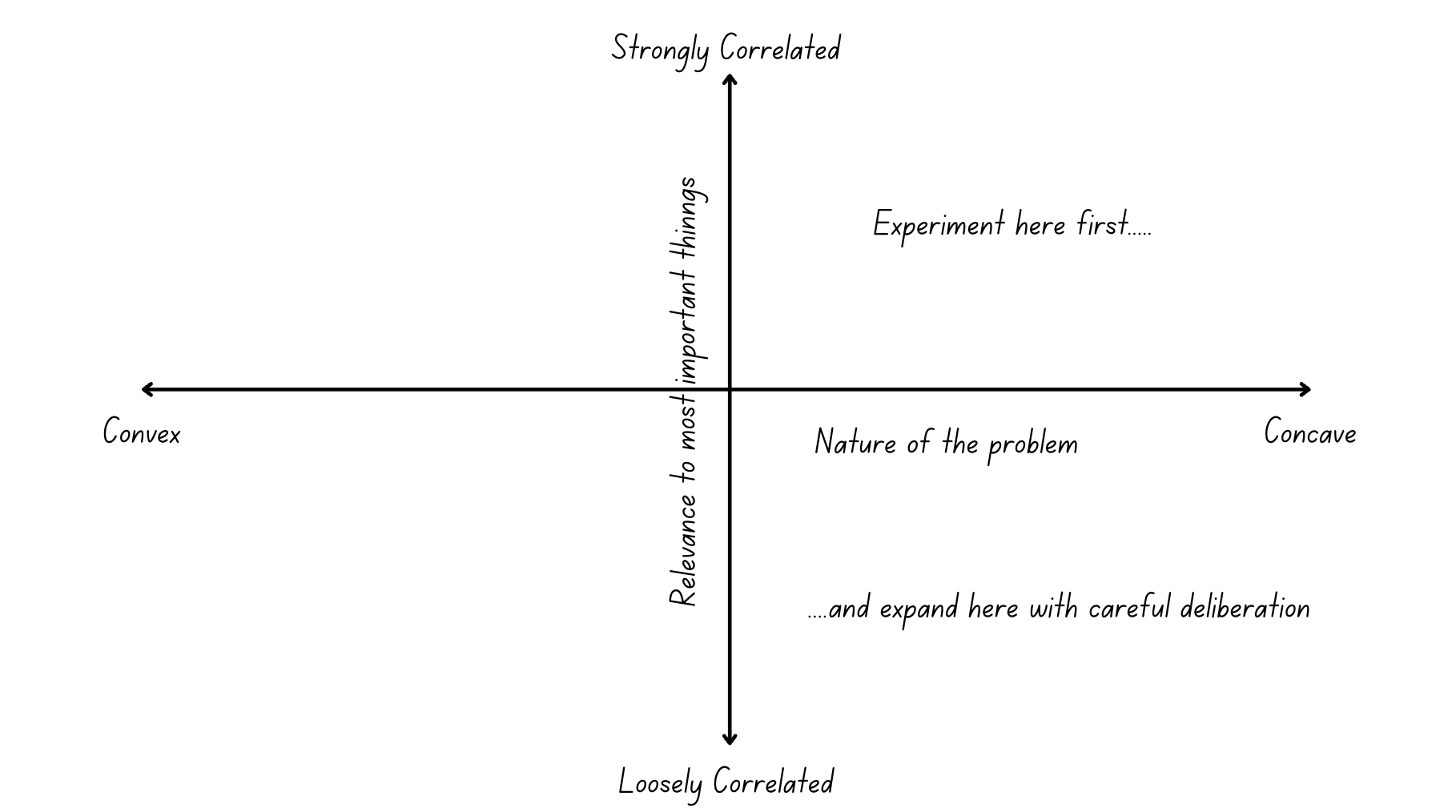
One hybrid approach that prioritizes the most important things for the DAO with inclusivity (especially in these times) might look like a framework below, where the work items that fall in the top-right quadrant might benefit from having a gateway to the community. This will take a few experiments that will have to vary by workstream to find a balance between efficiency and inclusivity, but more importantly, actualize decentralization beyond the votes on Snapshot. (Vitalik’s post about concave and convex worldviews is here)