Hi nollied, thanks for starting this discussion! I think its important to be willing to revisit & update our priors from time to time, so this conversation could serve as a nice discussion about “why QF”.
IMO this post jumps into solutioning (ditch QF) a bit too early for me. I think that it makes sense to explore the problem space a bit first. In this reply I am to do so by articulating the
- problems/cons of QF - starting with the discrete problems with QF you noted as currently implemented on Gitcoin Grants &
- what QF provides/pros of QF - what Gitcoin Grants gains from QF.
Here goes:
problems (cons)
In my opinion, the problems you noted are
- inaccurate match estimates
- privacy of sybil resistence
- computational complexity
I would also add these problems which you did not note (but I think about a lot)
- the necessity to keep raising matching pools
- collusion attacks
what QF provides (pros)
QF provides:
- (from the perspective of a contributor) - an incentive to get over the free rider problem by providing a matching contribution to every crowd contribution
- (from the perspective of an ecosystem)
- an opportunity to measure the signal of what your ecosystem participants want to fund,
- a way to push the power/responsibility of deciding what to fund away from a central grants team,
- and an opportunity to double(ish) your matching pool money (because contributors will crowdfund + this often doubles the amount of money that goes to those projects)
- (for everyone) - funding for projects supported by the poor/many instead of just the rich few
pros vs cons
The DAO should make its own decision (this post is just my thoughts) about the pros vs cons.
In my opinion,
- the juice QF provides is worth the squeeze,
- QF is a money lego for the space (similar to AMMs),
- but the approach Gitcoin Grants uses could be evolved.
The core reason I think QF is worth the effort that goes into it is that it is an elegant & scalable way of getting over the free rider problem, which is a core problem to solve for Gitcoin’s mission to build/fund digital public goods.
A secondary reason is that I’ve seen the most energy & excitement around QF of anything I’ve seen that Gitcoin has done over the last 5 years.
I also believe that the problems noted above have discrete solutions which could be explored:
- inaccurate match estimates => updated matching estimate algorithms
- privacy of sybil resistence => Proof of Personhood Passport, ZK tech, & MACI
- computational complexity => MACI or off-chain computation verifiable on-chain
- the necessity to keep raising matching pools => Gitcoin Aqueduct & How does the DAO prioritize side rounds?
- collusion attacks => MACI / pairwise
but I welcome differing views!
Grants 2.0
Have you seen this post? Gitcoin Grants 2.0. IMO Grants 2.0 is the successor to dGrants.
FWIW, Gitcoin Grants 2.0 has a Grants Registry at a base layer that does not have any opinions about what mechanisms should be built on top of it (see below diagram). One could build pairwise QF, MACI QF, retroactive public goods funding, dominance assurance contracts, or effective altruism on top of it.
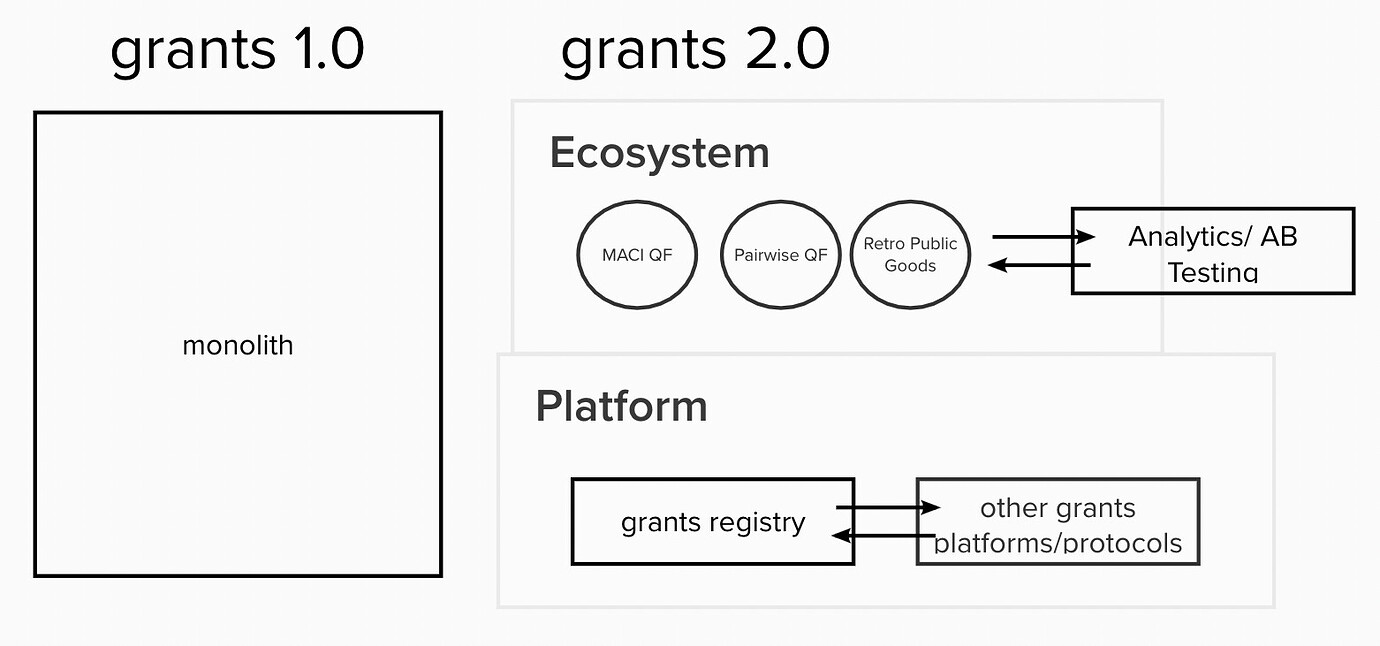
This is of course just my personal opinion + I welcome differing views !
Thanks again @nollied for starting the convo!
Disclaimer: This post is for informative purposes only and is not financial advice. This post reflects my personal views, not a decision or commitment by Gitcoin governance. Forward-looking items in it are targets, not commitments. The information in these posts is subject to change as we continue learning. This post may contain estimates, may contain errors, and is provided on a best-effort basis. DYOR, do not make any financial decisions based on these posts.